
-
 Email: admin@ytoptics.com
-
 English Inquiry Support:
-
 Add: 2# Automotive InnovationPark,
City,Jilin Province, China
An Analysis of the Optical Lens Polishing Process
The transformation of an optical lens from a glass blank into a transparent component capable of precisely controlling the propagation of light involves three major processing stages: rough grinding, fine grinding and polishing. Of these, polishing is the core process that determines the lens’s final optical performance, with polishing costs accounting for approximately 15 per cent of the total manufacturing cost. Building on an introduction to the principles and technical framework of the polishing process, this article illustrates the specific application of polishing technology in the manufacture of products at Changchun Yutai Optics Co.,Ltd. drawing on the company’s practical experience.
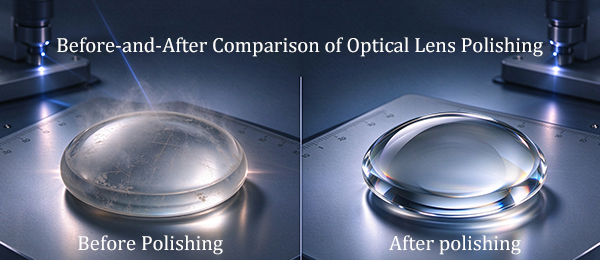
What is polishing?
Although lenses have already taken on a rough curved shape after coarse grinding, their surfaces are covered with layers of irregularities and micro-cracks, giving them a dull, opaque appearance. The purpose of polishing is to remove the residual surface irregularities and micro-cracks left after fine grinding, rendering the lens surface transparent and smooth, and ensuring it meets the specified surface roughness and surface defect requirements.
The mechanisms of polishing and grinding are essentially similar; both involve the removal of material through the relative movement of an abrasive against the workpiece surface. The distinction lies in the fact that grinding uses coarser abrasives to remove thicker layers of altered material, whilst polishing employs fine-grained polishing powder in conjunction with a soft polishing pad to remove extremely thin layers of material in a slower and more precise manner. During the polishing process, polishing powders such as cerium oxide react chemically with the glass surface to form a soft layer that is easily removed, which is then removed through mechanical friction. Regarding the mechanism of polishing, the currently accepted view is that mechanical abrasion is fundamental, chemical action is significant, and the theory of surface flow also holds true under certain conditions. The surface roughness of polished lenses is typically controlled to the nanometre level, whilst surface form accuracy can reach the sub-micrometre level or even higher.
Material Systems and Key Parameters of the Polishing Process
The choice of polishing compound varies according to precision requirements. In classical polishing, polishing pitch is prepared by boiling asphalt and rosin; its hardness can be adjusted by varying the proportion of rosin, and it remains the material of choice for the machining of high-precision flat optical components to this day. In high-speed polishing, polyurethane polishing pads are widely used; their microporous structure facilitates the uniform distribution of the polishing slurry, whilst offering minimal deformation and a long service life, making them suitable for the efficient machining of medium- to low-precision lenses.
With regard to polishing slurry, cerium oxide is the most widely used polishing agent in the manufacture of precision optical components due to its high polishing ability. The particle size is typically controlled between 1 and 10 μm, the slurry concentration is generally maintained at 10%–15% (by weight), and the feed rate is controlled at approximately 0.9–1 L/min.
Key Elements and Parameters of Traditional Polishing Processes
|
Process Elements |
Typical Materials/Parameters |
Functional Role |
|
Polishing mould |
Polyurethane sheet, polishing tar |
Holds abrasives, transmits pressure |
|
Polishing slurry |
Cerium oxide, particle size 1–5 μm |
Chemical-mechanical removal |
|
Process Parameters |
Rotational speed 120–200 r/min |
Controls removal rate |
Breakthroughs in Advanced Polishing Technologies
Traditional polishing relies on manual expertise, with surface profile accuracy limited by mould alignment and the operator’s skill. The advent of Computer-Controlled Optical Surface (CCOS) technology has transformed this situation. CCOS treats the polishing process as ‘deterministic machining’: based on surface profile error data, it achieves quantitative material removal by controlling the dwell time, speed and pressure of the tool head, thereby significantly enhancing the machining accuracy and repeatability of aspheric lenses.
Building upon CCOS, magnetorheological polishing and air-cushion polishing have further expanded the boundaries of what is possible. Magnetorheological polishing utilises a ‘flexible polishing mould’ formed by magnetorheological fluid under the influence of a magnetic field; its shape and hardness can be adjusted in real time, enabling nanometre-level surface roughness to be achieved without causing subsurface damage. Air-cushion polishing, on the other hand, replaces rigid tool heads with flexible air cushions; by adjusting the air pressure, the polishing surface adapts to the curvature of the lens, and this technique is already being used in the pre-processing stage of lithography objectives.
Yutai Optics’ Polishing Process Positioning and Practice
Yutai Optics is an ISO 9001-certified manufacturer of precision optical components, specialising in spherical lenses, windows, mirrors, filters, prisms and other products, which are widely used in smart manufacturing, healthcare, laser technology and aerospace sectors. The company operates a 3,800-square-metre production facility that integrates optical blank grinding, fine grinding and polishing, precision coating and inspection. Its core strength lies in the rapid prototyping and stable mass production of small-to-medium-batch, medium-to-high-precision optical components.
Within Yutai Optics’ manufacturing process, the polishing stage occupies a pivotal position, bridging the preceding and subsequent stages. After lenses have undergone rough grinding for shaping and fine grinding for refinement, they enter the polishing stage; the quality of this polishing directly determines whether the subsequent coating process can proceed smoothly and whether the final product will meet the optical performance specifications required by the customer.
Taking spherical lenses—the company’s main product—as an example, process control in the polishing stage is directly reflected in three key indicators: surface roughness affects light transmittance and scattering loss; surface form accuracy determines the degree of wavefront distortion; and surface defects (scratches, pits) determine the product’s visual acceptance. For lenses or windows used in laser systems, any polishing defect may lead to a reduction in the laser damage threshold; consequently, the requirements for polishing cleanliness and subsurface quality are extremely stringent.
Process Trends and Outlook
For the company, building upon traditional high-speed polyurethane polishing and cerium oxide systems whilst gradually introducing the process control principles of CNC polishing to enhance the consistency and repeatability of small-to-medium batch orders represents a viable path to consolidating its market positioning as a provider of ‘medium-to-high precision and rapid prototyping’. Polishing is not merely a simple ‘smoothing’ process, but a precision technology that integrates mechanical removal, chemical reactions and process expertise; it is also a key manifestation of a company’s integrated capability from blank to finished product. From blank to lens, from rough grinding to polishing, the cumulative precision of every process step ultimately crystallises in that single beam of light passing through the lens.
If you are looking for a partner for optical components, or have any queries or bespoke requirements regarding polishing processes, why not get in touch with us? Changchun Yutai Optics Co.,Ltd. looks forward to hearing from you.


NEXT : From Microns to Nanometers: How Optical Components Support the Limits of Precision in Semiconductor
 86-15584132290
Call us now!

 2433808388