ISO9001 Certified Professional Manufacturer & Supplier of Optics
+86-0431-87911611 admin@ytoptics.com

Contact us
-
 Email: admin@ytoptics.com
-
 English Inquiry Support:
-
 Add: 2# Automotive InnovationPark,
City,Jilin Province, China
What coating is suitable for CVD ZnS dome?
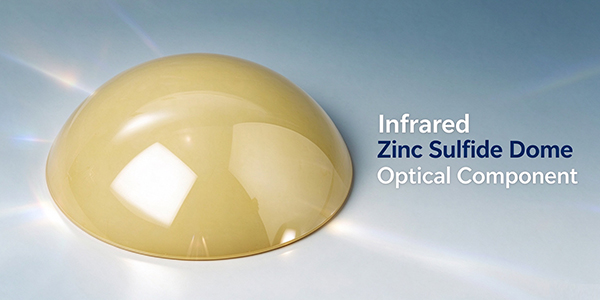
When selecting a coating for CVD Zns domes, the optimal choice is either a DLC/BP (diamond-like carbon/boron phosphide) bilayer structure or an a-D/a-Ge₁₋ₓCₓ:H (amorphous diamond/amorphous germanium hydride carbon) multilayer structure. The former enables the zinc sulfide dome to achieve an average transmittance of approximately 87.9% in the 8–12 μm wavelength band, while increasing the nanohardness from the substrate’s 2.5 GPa to 19.5 GPa; the latter deposits an amorphous diamond layer using filtered cathode vacuum arc (FCVA) technology, combined with a germanium-carbon intermediate layer to resolve adhesion issues.
I. Coating Requirements for Zinc Sulfide Domes: Why Is Coating Necessary?
CVD-deposited zinc sulfide domes are the material of choice for long-wave infrared (LWIR, 8–12 μm) domes and windows because they combine good infrared transmittance with mechanical strength superior to that of zinc selenide. However, the bare zinc sulfide surface has two critical flaws: high reflection loss (approximately 24.7% on one side and nearly 50% on both sides) and insufficient resistance to rain and sand erosion. For missile or airborne optoelectronic sensor domes exposed to high-speed airflow, the uncoated zinc sulfide surface degrades rapidly upon impact with raindrops, directly leading to a decline in infrared imaging quality.
Therefore, an ideal coating must fulfill two functions simultaneously: reducing reflection (to improve transmittance) and providing hard protection (to resist environmental erosion). These two objectives often conflict in terms of material selection—materials with high hardness typically also have high refractive indices, and using them solely as an outer layer would exacerbate reflection; thus, a multilayer structure design becomes essential.
II. Two Mainstream Coating Solutions and Their Parameters
Solution 1: DLC/BP Dual-Layer Protective and Anti-Reflective Coating
This is the most classic “hard-outer, soft-inner” structure for zinc sulfide substrates. The outer layer uses a combination of diamond-like carbon (DLC) and boron phosphide (BP), while the inner layer consists of a YbF₃/ZnS anti-reflective layer deposited on the opposite side of the substrate.
Key Parameters: In the 8–12 μm wavelength range, the maximum transmittance after double-sided coating reaches approximately 93.3%, with an average transmittance of 87.9%. The improvement in mechanical properties is even more significant: the DLC/BP coating caused the nanohardness of the zinc sulfide sample to jump from the substrate’s 2.5 GPa to 19.5 GPa—an increase of nearly eightfold. This coating system passed the simulated harsh environment testing required by the MIL-48616 standard, validating its engineering reliability.
BP’s high refractive index (approximately 3) means it cannot function as an anti-reflection layer on its own (with a minimum reflectance of approximately 15% for a single layer); however, when combined with low-refractive-index DLC, the multilayer interference effect actually achieves excellent anti-reflection performance. The ingenuity of this design lies in its “dual-purpose” approach: BP provides the hardness framework, while DLC adjusts the optical matching.
Option 2: a-D/a-Ge₁₋ₓCₓ:H Multilayer System
This approach uses amorphous diamond (a-D) as the hard outer layer and employs an intermediate layer of amorphous germanium hydride carbon (a-Ge₁₋ₓCₓ:H) to address the poor adhesion between a-D and ZnS.
a-D is deposited at room temperature using filtered cathode vacuum arc (FCVA) technology; its hardness is close to that of diamond, while its surface smoothness is superior to that of polycrystalline diamond films, making it suitable for the uniform coating of large-aperture optical components. The a-Ge₁₋ₓCₓ:H layer is prepared via radio-frequency (RF) sputtering; its refractive index can be adjusted over a wide range by varying the gas flow ratio, thereby achieving the dual objectives of optical matching and enhanced adhesion.
The advantage of this approach lies in its process compatibility: both FCVA and RF sputtering are low-temperature processes that do not cause thermal damage to the zinc sulfide substrate.
III. Other Alternatives and Limitations
A four-layer germanium/zinc sulfide anti-reflective coating deposited using PVD technology achieves an average transmittance of 96% after double-sided coating in the 8–12 μm wavelength range, while a Y₂O₃/carbon protective layer enhances hardness. However, this approach offers weaker protection than the DLC system and is more suitable for applications requiring extremely high transmittance where the risk of environmental corrosion is relatively controlled.
Attempts at sol-gel aluminum oxide coatings are worth noting; however, the transparency range of aluminum oxide primarily covers 0.5–4.6 μm, limiting its transmittance in the LWIR band.
Diamond composite coatings represent a cutting-edge direction, leveraging the extremely high hardness of diamond in conjunction with a germanium intermediate layer to achieve refractive index matching; however, deposition temperature control and process complexity remain engineering bottlenecks.
IV. Yutai Optics’ CVD Zinc Sulfide Dome Coating Capabilities and Collaboration Opportunities
Yutai Optics possesses clear entry points and engineering potential in the field of CVD zinc sulfide domes and associated coatings.
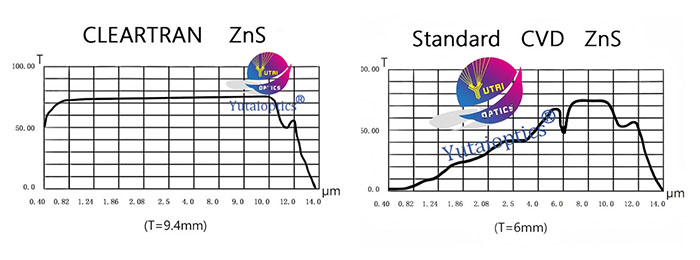
In terms of substrate materials, Yutai Optics already offers two product lines: CVD ZnS and Multispectral ZnS (Cleartran). After hot isostatic pressing (HIP) treatment, the latter’s transmission band extends from LWIR to visible–far-infrared (0.4–12 μm), meeting the core requirements for dome materials in multispectral detection applications. This material capability is a prerequisite for the successful implementation of the coating process.
In terms of testing and quality control, Yutai Optics has obtained ISO 9001 certification and possesses a comprehensive quality control framework covering the entire process from raw material receipt to finished product shipment. For dome-type products, it is recommended to supplement the existing system with two key validation capabilities—rain erosion testing and nanoindentation hardness testing—to quantify the protective effectiveness of the coatings under actual service conditions. These two metrics are also the performance indicators that customers prioritize most when selecting products.
The selection of coatings for CVD zinc sulfide dome covers ultimately depends on specific operating conditions, wavelength requirements, and environmental ratings. If you are looking for substrate or coating solutions for dome covers in infrared systems, please feel free to contact us to discuss your specific needs. We look forward to advancing engineering collaborations on high-performance zinc sulfide dome covers through actual samples and quantifiable performance data.
Contact Us
Changchun Yutai Optics Co.,Ltd.
Address: 2# Automotive InnovationPark,Liando U Valley, ChangchunCity,Jilin Province, China
Email: admin@ytoptics.com
Phone: 86-15584132290
I. Coating Requirements for Zinc Sulfide Domes: Why Is Coating Necessary?
CVD-deposited zinc sulfide domes are the material of choice for long-wave infrared (LWIR, 8–12 μm) domes and windows because they combine good infrared transmittance with mechanical strength superior to that of zinc selenide. However, the bare zinc sulfide surface has two critical flaws: high reflection loss (approximately 24.7% on one side and nearly 50% on both sides) and insufficient resistance to rain and sand erosion. For missile or airborne optoelectronic sensor domes exposed to high-speed airflow, the uncoated zinc sulfide surface degrades rapidly upon impact with raindrops, directly leading to a decline in infrared imaging quality.
Therefore, an ideal coating must fulfill two functions simultaneously: reducing reflection (to improve transmittance) and providing hard protection (to resist environmental erosion). These two objectives often conflict in terms of material selection—materials with high hardness typically also have high refractive indices, and using them solely as an outer layer would exacerbate reflection; thus, a multilayer structure design becomes essential.
II. Two Mainstream Coating Solutions and Their Parameters
Solution 1: DLC/BP Dual-Layer Protective and Anti-Reflective Coating
This is the most classic “hard-outer, soft-inner” structure for zinc sulfide substrates. The outer layer uses a combination of diamond-like carbon (DLC) and boron phosphide (BP), while the inner layer consists of a YbF₃/ZnS anti-reflective layer deposited on the opposite side of the substrate.
Key Parameters: In the 8–12 μm wavelength range, the maximum transmittance after double-sided coating reaches approximately 93.3%, with an average transmittance of 87.9%. The improvement in mechanical properties is even more significant: the DLC/BP coating caused the nanohardness of the zinc sulfide sample to jump from the substrate’s 2.5 GPa to 19.5 GPa—an increase of nearly eightfold. This coating system passed the simulated harsh environment testing required by the MIL-48616 standard, validating its engineering reliability.
BP’s high refractive index (approximately 3) means it cannot function as an anti-reflection layer on its own (with a minimum reflectance of approximately 15% for a single layer); however, when combined with low-refractive-index DLC, the multilayer interference effect actually achieves excellent anti-reflection performance. The ingenuity of this design lies in its “dual-purpose” approach: BP provides the hardness framework, while DLC adjusts the optical matching.
Option 2: a-D/a-Ge₁₋ₓCₓ:H Multilayer System
This approach uses amorphous diamond (a-D) as the hard outer layer and employs an intermediate layer of amorphous germanium hydride carbon (a-Ge₁₋ₓCₓ:H) to address the poor adhesion between a-D and ZnS.
a-D is deposited at room temperature using filtered cathode vacuum arc (FCVA) technology; its hardness is close to that of diamond, while its surface smoothness is superior to that of polycrystalline diamond films, making it suitable for the uniform coating of large-aperture optical components. The a-Ge₁₋ₓCₓ:H layer is prepared via radio-frequency (RF) sputtering; its refractive index can be adjusted over a wide range by varying the gas flow ratio, thereby achieving the dual objectives of optical matching and enhanced adhesion.
The advantage of this approach lies in its process compatibility: both FCVA and RF sputtering are low-temperature processes that do not cause thermal damage to the zinc sulfide substrate.
III. Other Alternatives and Limitations
A four-layer germanium/zinc sulfide anti-reflective coating deposited using PVD technology achieves an average transmittance of 96% after double-sided coating in the 8–12 μm wavelength range, while a Y₂O₃/carbon protective layer enhances hardness. However, this approach offers weaker protection than the DLC system and is more suitable for applications requiring extremely high transmittance where the risk of environmental corrosion is relatively controlled.
Attempts at sol-gel aluminum oxide coatings are worth noting; however, the transparency range of aluminum oxide primarily covers 0.5–4.6 μm, limiting its transmittance in the LWIR band.
Diamond composite coatings represent a cutting-edge direction, leveraging the extremely high hardness of diamond in conjunction with a germanium intermediate layer to achieve refractive index matching; however, deposition temperature control and process complexity remain engineering bottlenecks.
IV. Yutai Optics’ CVD Zinc Sulfide Dome Coating Capabilities and Collaboration Opportunities
Yutai Optics possesses clear entry points and engineering potential in the field of CVD zinc sulfide domes and associated coatings.
In terms of substrate materials, Yutai Optics already offers two product lines: CVD ZnS and Multispectral ZnS (Cleartran). After hot isostatic pressing (HIP) treatment, the latter’s transmission band extends from LWIR to visible–far-infrared (0.4–12 μm), meeting the core requirements for dome materials in multispectral detection applications. This material capability is a prerequisite for the successful implementation of the coating process.
In terms of testing and quality control, Yutai Optics has obtained ISO 9001 certification and possesses a comprehensive quality control framework covering the entire process from raw material receipt to finished product shipment. For dome-type products, it is recommended to supplement the existing system with two key validation capabilities—rain erosion testing and nanoindentation hardness testing—to quantify the protective effectiveness of the coatings under actual service conditions. These two metrics are also the performance indicators that customers prioritize most when selecting products.
The selection of coatings for CVD zinc sulfide dome covers ultimately depends on specific operating conditions, wavelength requirements, and environmental ratings. If you are looking for substrate or coating solutions for dome covers in infrared systems, please feel free to contact us to discuss your specific needs. We look forward to advancing engineering collaborations on high-performance zinc sulfide dome covers through actual samples and quantifiable performance data.
Contact Us
Changchun Yutai Optics Co.,Ltd.
Address: 2# Automotive InnovationPark,Liando U Valley, ChangchunCity,Jilin Province, China
Email: admin@ytoptics.com
Phone: 86-15584132290
Share this:


TALK TO US 86-15584132290
Call us now!
86-15584132290Call us now!

ONLINE CHAT
 2433808388
2433808388