ISO9001 Certified Professional Manufacturer & Supplier of Optics
+86-0431-87911611 admin@ytoptics.com

Contact us
-
 Email: admin@ytoptics.com
-
 English Inquiry Support:
-
 Add: 2# Automotive InnovationPark,
City,Jilin Province, China
From Rough Grinding to Coating: A Technical Breakdown of the Optical Component Manufacturing Process
The manufacture of optical components is a systematic engineering process that integrates materials science, precision mechanics, and optical theory. A lens that appears transparent and flawless undergoes a transformation from loose particles to a nanoscale-smooth surface. Its classic cold-processing workflow—rough grinding, fine grinding, polishing, cleaning, inspection, and coating—forms the cornerstone of the modern optical industry, with each step carrying the mandate of achieving exacting precision.
Rough Grinding: Shaping the Blank into Its Contours
The process begins with rough grinding, whose core task is “shaping.” In this stage, coarse-grained diamond or silicon carbide abrasives are used in conjunction with a rigid mold to perform high-speed milling and grinding on the optical glass blank. This process is designed to rapidly remove excess material and establish the lens’s macro-geometric dimensions—such as the radius of curvature, outer diameter, and central thickness—at a preliminary stage. The surface after rough grinding is covered with grinding marks of varying depths, and the surface finish is typically low; this stage essentially lays the geometric foundation for subsequent precision machining.
Fine Grinding and Polishing: A Dual Leap in Precision and Smoothness
Fine grinding (also known as precision grinding) is a critical intermediate step. This process uses finer-grained abrasives (such as alumina or diamond micropowder) to gradually remove the damaged layer left by rough grinding under strictly controlled pressure and rotational speed conditions. This stage not only corrects surface form errors (such as spherical aberration) but also reduces surface roughness to the micrometer level, providing a transitional surface for the final polishing.
The subsequent polishing is the core process that determines optical performance. Unlike the “material removal” of fine grinding, polishing focuses more on “surface shaping.” It utilizes soft polishing media (such as polyurethane or asphalt) in conjunction with nanoscale polishing slurries (such as cerium oxide suspensions) to remove microscopic cracks and imperfections from the surface through mechanochemical action. For extremely high-precision components, advanced technologies such as ion beam polishing may even be required to achieve atomic-level material removal through physical sputtering effects, thereby correcting sub-nanometer-level surface form errors.
Post-Processing and Functionalization: Cleaning, Inspection, and Coating
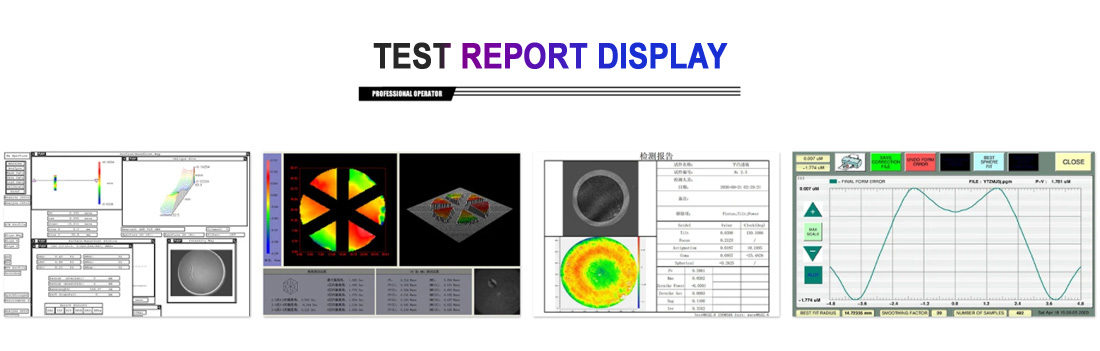
After polishing is complete, polishing powder and organic residues remain on the component surface, which must undergo thorough cleaning. Ultrasonic cleaning combined with rinsing with deionized water is typically used to ensure the surface cleanliness meets the coating requirements. This is followed by the inspection phase, where high-precision equipment such as interferometers and profilometers is used to perform final inspections of the finished product’s surface profile accuracy (PV value), roughness (Ra), and aperture number to verify compliance with design specifications.
The final stage of the process is coating. Since the bare glass surface exhibits approximately 4%–10% reflection loss, one or more layers of nanoscale films are deposited onto the lens surface in a vacuum coating system using electron beam evaporation or sputtering technology. Common anti-reflective coatings can increase light transmittance to over 99.5%, while for specific applications, reflective or filter coatings can also be applied to impart specific spectral characteristics to the lens.
In summary, the processing of optical components is a chain in which precision is passed down through each stage. Rough grinding shapes the component, fine grinding eliminates defects, and polishing creates a smooth surface, while cleaning, inspection, and coating impart its final application value. In this chain, errors in each process step accumulate and are amplified; therefore, precise control of process parameters and stringent testing requirements are the eternal principles for manufacturing high-quality optical components.
The process begins with rough grinding, whose core task is “shaping.” In this stage, coarse-grained diamond or silicon carbide abrasives are used in conjunction with a rigid mold to perform high-speed milling and grinding on the optical glass blank. This process is designed to rapidly remove excess material and establish the lens’s macro-geometric dimensions—such as the radius of curvature, outer diameter, and central thickness—at a preliminary stage. The surface after rough grinding is covered with grinding marks of varying depths, and the surface finish is typically low; this stage essentially lays the geometric foundation for subsequent precision machining.
Fine Grinding and Polishing: A Dual Leap in Precision and Smoothness
Fine grinding (also known as precision grinding) is a critical intermediate step. This process uses finer-grained abrasives (such as alumina or diamond micropowder) to gradually remove the damaged layer left by rough grinding under strictly controlled pressure and rotational speed conditions. This stage not only corrects surface form errors (such as spherical aberration) but also reduces surface roughness to the micrometer level, providing a transitional surface for the final polishing.
The subsequent polishing is the core process that determines optical performance. Unlike the “material removal” of fine grinding, polishing focuses more on “surface shaping.” It utilizes soft polishing media (such as polyurethane or asphalt) in conjunction with nanoscale polishing slurries (such as cerium oxide suspensions) to remove microscopic cracks and imperfections from the surface through mechanochemical action. For extremely high-precision components, advanced technologies such as ion beam polishing may even be required to achieve atomic-level material removal through physical sputtering effects, thereby correcting sub-nanometer-level surface form errors.
Post-Processing and Functionalization: Cleaning, Inspection, and Coating
After polishing is complete, polishing powder and organic residues remain on the component surface, which must undergo thorough cleaning. Ultrasonic cleaning combined with rinsing with deionized water is typically used to ensure the surface cleanliness meets the coating requirements. This is followed by the inspection phase, where high-precision equipment such as interferometers and profilometers is used to perform final inspections of the finished product’s surface profile accuracy (PV value), roughness (Ra), and aperture number to verify compliance with design specifications.
The final stage of the process is coating. Since the bare glass surface exhibits approximately 4%–10% reflection loss, one or more layers of nanoscale films are deposited onto the lens surface in a vacuum coating system using electron beam evaporation or sputtering technology. Common anti-reflective coatings can increase light transmittance to over 99.5%, while for specific applications, reflective or filter coatings can also be applied to impart specific spectral characteristics to the lens.
In summary, the processing of optical components is a chain in which precision is passed down through each stage. Rough grinding shapes the component, fine grinding eliminates defects, and polishing creates a smooth surface, while cleaning, inspection, and coating impart its final application value. In this chain, errors in each process step accumulate and are amplified; therefore, precise control of process parameters and stringent testing requirements are the eternal principles for manufacturing high-quality optical components.
Share this:


PREV : Large-Size Stepped Windows: Overcoming the Challenge of Integrating Mechanics and Optics in the “Las NEXT : Engineering Considerations for Optical Window Parallelism
TALK TO US 86-15584132290
Call us now!
86-15584132290Call us now!

ONLINE CHAT
 2433808388
2433808388