ISO9001 Certified Professional Manufacturer & Supplier of Optics
+86-0431-87911611 admin@ytoptics.com

Contact us
-
 Email: admin@ytoptics.com
-
 English Inquiry Support:
-
 Add: 2# Automotive InnovationPark,
City,Jilin Province, China
Large-Size Stepped Windows: Overcoming the Challenge of Integrating Mechanics and Optics in the “Las
In the design of precision optical systems, engineers often face a dilemma: windows must not only ensure broad-spectrum optical transmission with high wavefront accuracy but also fulfill mechanical functions such as vacuum sealing, precision positioning, and even high-pressure protection. Traditional flat windows often fail to address both requirements simultaneously—components with excellent optical performance are difficult to install, while structurally robust windows compromise imaging quality.
The emergence of large-size rectangular stepped windows is redefining the value boundaries of optical windows through an “optical-mechanical integration” design philosophy.
Stepped Structure: From Passive Protection to Active Participation in System Integration
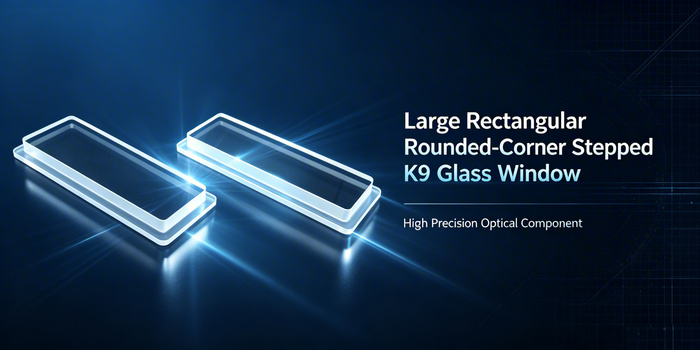
Traditional windows are often limited to the role of a “protective cover,” whereas stepped windows—by machining precise stepped surfaces along their edges—transform from passive components into active parts that participate in opto-mechanical system integration. The stepped structure serves as a precise stop and positioning surface, mating directly with mirror mounts and flanges to eliminate the need for complex shim adjustments. In applications such as laser systems and vacuum chambers—where repeatable installation accuracy is critical—this significantly improves assembly efficiency and optical path consistency.
At the same time, the combination of large rectangular dimensions and rounded corners effectively addresses stress concentration issues. Compared to right-angle edges, the rounded corner design significantly reduces the risk of the window fracturing due to installation forces in high-pressure or vacuum environments, while also facilitating the use of O-rings to enhance sealing performance.
Materials and Processing: How to Achieve High-Precision Stepped Profiles in Hard, Brittle Materials?
The manufacturing challenges of large-size stepped windows center on the “dimension–precision–material brittleness” trilemma. Taking K9 (BK7 equivalent) optical glass as an example, its broad spectral transmission range (350 nm–2000 nm) and excellent hardness make it a mainstream choice; however, its hard and brittle nature places extremely high demands on the grinding process.
Currently, industry-leading manufacturers have achieved precision machining of large-sized rectangular stepped windows, with dimensions reaching several hundred millimeters, surface profile accuracy better than λ/4 (at 633 nm), surface quality at the 20/10 scratch/dig level, and step tolerances controlled within the range of ±0.05 mm to ±0.1 mm. The realization of high-precision steps relies on the synergy between specialized prism milling and grinding equipment and diamond grinding wheels. By optimizing grinding parameters and fixture design, edge chipping and subsurface damage are avoided while ensuring the perpendicularity and surface profile accuracy of the step faces.
Applications: Who Needs “Stepped Windows”?
Typical applications for large-size rectangular stepped windows are concentrated in three major areas:
1. Vacuum and high-pressure optical chambers: The stepped structure ensures precise positioning of the window during flange installation. Combined with metal or rubber O-rings, it achieves a highly reliable seal, meeting the stringent leakage rate requirements of semiconductor PVD/CVD equipment, space simulation chambers, and other applications.
2. High-Power Laser Systems: Large-size windows provide a sufficient aperture for light transmission, while the stepped structure ensures repeatable optical alignment. High-quality optical glass substrates combined with anti-reflective (AR) coatings minimize reflection losses and protect the interior of the laser from contamination.
3. Underwater and Harsh-Environment Optical Equipment: The rectangular shape accommodates specific field-of-view requirements, while the stepped and sealed structures work in concert to ensure the window operates reliably over the long term at depths of several thousand meters underwater or in high-temperature, high-humidity environments.
Large-size rectangular stepped windows are not merely optical components; they are the product of a systems integration approach. They advance optical performance and mechanical functionality from “separate and compromised” to “integrated and optimized,” achieving a delicate balance across the three dimensions of optics, mechanics, and materials. For engineers pursuing ultimate system performance, this “stepped window” deserves serious consideration.
Traditional windows are often limited to the role of a “protective cover,” whereas stepped windows—by machining precise stepped surfaces along their edges—transform from passive components into active parts that participate in opto-mechanical system integration. The stepped structure serves as a precise stop and positioning surface, mating directly with mirror mounts and flanges to eliminate the need for complex shim adjustments. In applications such as laser systems and vacuum chambers—where repeatable installation accuracy is critical—this significantly improves assembly efficiency and optical path consistency.
At the same time, the combination of large rectangular dimensions and rounded corners effectively addresses stress concentration issues. Compared to right-angle edges, the rounded corner design significantly reduces the risk of the window fracturing due to installation forces in high-pressure or vacuum environments, while also facilitating the use of O-rings to enhance sealing performance.
Materials and Processing: How to Achieve High-Precision Stepped Profiles in Hard, Brittle Materials?
The manufacturing challenges of large-size stepped windows center on the “dimension–precision–material brittleness” trilemma. Taking K9 (BK7 equivalent) optical glass as an example, its broad spectral transmission range (350 nm–2000 nm) and excellent hardness make it a mainstream choice; however, its hard and brittle nature places extremely high demands on the grinding process.
Currently, industry-leading manufacturers have achieved precision machining of large-sized rectangular stepped windows, with dimensions reaching several hundred millimeters, surface profile accuracy better than λ/4 (at 633 nm), surface quality at the 20/10 scratch/dig level, and step tolerances controlled within the range of ±0.05 mm to ±0.1 mm. The realization of high-precision steps relies on the synergy between specialized prism milling and grinding equipment and diamond grinding wheels. By optimizing grinding parameters and fixture design, edge chipping and subsurface damage are avoided while ensuring the perpendicularity and surface profile accuracy of the step faces.
Applications: Who Needs “Stepped Windows”?
Typical applications for large-size rectangular stepped windows are concentrated in three major areas:
1. Vacuum and high-pressure optical chambers: The stepped structure ensures precise positioning of the window during flange installation. Combined with metal or rubber O-rings, it achieves a highly reliable seal, meeting the stringent leakage rate requirements of semiconductor PVD/CVD equipment, space simulation chambers, and other applications.
2. High-Power Laser Systems: Large-size windows provide a sufficient aperture for light transmission, while the stepped structure ensures repeatable optical alignment. High-quality optical glass substrates combined with anti-reflective (AR) coatings minimize reflection losses and protect the interior of the laser from contamination.
3. Underwater and Harsh-Environment Optical Equipment: The rectangular shape accommodates specific field-of-view requirements, while the stepped and sealed structures work in concert to ensure the window operates reliably over the long term at depths of several thousand meters underwater or in high-temperature, high-humidity environments.
Large-size rectangular stepped windows are not merely optical components; they are the product of a systems integration approach. They advance optical performance and mechanical functionality from “separate and compromised” to “integrated and optimized,” achieving a delicate balance across the three dimensions of optics, mechanics, and materials. For engineers pursuing ultimate system performance, this “stepped window” deserves serious consideration.
Share this:


PREV : Broadband Anti-Reflection Coating (BBAR): From Principles to Applications—Unlocking the “Transparenc NEXT : From Rough Grinding to Coating: A Technical Breakdown of the Optical Component Manufacturing Process
TALK TO US 86-15584132290
Call us now!
86-15584132290Call us now!

ONLINE CHAT
 2433808388
2433808388