ISO9001 Certified Professional Manufacturer & Supplier of Optics
+86-0431-87911611 admin@ytoptics.com

Contact us
-
 Email: admin@ytoptics.com
-
 English Inquiry Support:
-
 Add: 2# Automotive InnovationPark,
City,Jilin Province, China
The Appropriate Positioning of K9 Optical Glass in Precision Optical Components
In optical system design, the choice of substrate material is never a simple decision. Fused silica and glass-ceramics have become the go-to choices for high-end applications due to their excellent thermal stability, yet their high cost and long processing lead times put them out of reach for many projects.
So, does a "good enough" and "affordable" alternative exist?
For decades, H-K9L optical glass has been the baseline material for visible and near-infrared optics. Its value proposition is undeniable—but when is it the smart choice, and when should you move up to something better?
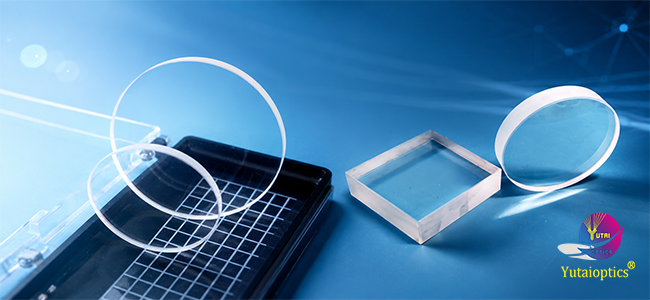
So, does a "good enough" and "affordable" alternative exist?
For decades, H-K9L optical glass has been the baseline material for visible and near-infrared optics. Its value proposition is undeniable—but when is it the smart choice, and when should you move up to something better?
1. Core Parameter Comparison of Three Common Substrate Materials
Glass-Ceramic: Offers extreme performance but at a very high cost. Suitable for astronomical telescope mirror blanks, spaceborne optical reference cavities, and other scenarios with extremely stringent temperature control requirements.
Fused Silica: The material of choice for the UV band and high-power laser applications. It delivers well-rounded performance, but its cost is significantly higher than that of H-K9L.
H-K9L: Provides the best cost-effectiveness, covering the vast majority of visible and near-infrared applications.
2. The True Performance Boundary of H-K9L
Thermal Stability Assessment
The coefficient of thermal expansion (CTE) of H-K9L is approximately 13 times that of fused silica and 140 times that of glass-ceramic. At first glance, these numbers seem daunting, but they must be interpreted within the context of real-world operating conditions.
Key question: At what temperature difference does thermal deformation of H-K9L become a concern?
Consider a mirror with a diameter of 25 mm and a thickness of 5 mm as an example:
At a temperature difference ΔT = 5°C, the thermal expansion displacement of H-K9L is approximately 0.9 μm, while that of fused silica is about 0.07 μm.
For most imaging systems or laser pointing systems, a thermal drift of 0.9 μm remains within an acceptable range.
When ΔT reaches 20°C, the displacement of H-K9L increases to approximately 3.6 μm. At this point, some high-resolution systems may begin to experience performance degradation.
Practical conclusion: In well-temperature-controlled indoor environments (ΔT < 10°C), the thermal performance of H-K9L is entirely sufficient.
Optical Transmission Comparison
In the visible region (400–700 nm), the three materials show negligible differences in internal transmittance, all exceeding 99.5% per 10 mm thickness.
The dividing line appears in the ultraviolet band (<350 nm):
H-K9L's transmittance drops sharply below 350 nm, falling to below 80% at 300 nm.
In contrast, fused silica still maintains >90% transmittance at 193 nm.
Practical conclusion: For ultraviolet applications, fused silica is the unambiguous choice. H-K9L has no competitive advantage in this wavelength range
Laser-Induced Damage Threshold
For continuous-wave (CW) lasers, the absorption coefficient of H-K9L is slightly higher than that of fused silica (due to differences in impurity content). However, this difference is negligible in low-power (50 W/cm²) conditions.
For pulsed lasers, H-K9L performs stably at nanosecond pulse widths with energy densities below 1 J/cm². At higher energy densities or at the picosecond/femtosecond level, the advantages of fused silica begin to emerge.
3.When to Choose H-K9L and When to Upgrade?
Recommended Scenarios for Choosing H-K9L
Recommended Scenarios for Upgrading to Fused Silica
Scenarios Requiring Consideration of Glass-Ceramic
4.Yutai Optics' H-K9L Component Fabrication Capabilities
Coating options: Protective aluminum, UV aluminum, silver, gold, anti-reflection (AR), dielectric high-reflection (HR).
5. Conclusion
H-K9L is not a "cheap substitute" but rather the benchmark material for optical components in the visible and near-infrared bands. Within its appropriate application scenarios, its performance is entirely sufficient.
The marginal return on material upgrades diminishes significantly: upgrading from H-K9L to fused silica increases cost by a factor of 3–5, yet the performance gain is only practically meaningful in specific scenarios such as UV applications, high-power lasers, or large temperature variations.
The core of rational material selection lies in identifying the true performance bottleneck of the system, rather than blindly pursuing the "best" material.
A hybrid approach is worth considering: use fused silica for critical components and H-K9L for non-critical ones, achieving an optimal balance between performance and budget.
The art of optical design is not about stacking the best materials, but about using the right materials to meet real engineering needs.
|
Parameter |
H-K9L |
Fused Silica |
Glass-Ceramic |
|
Coefficient of thermal expansion (20°C) |
~7.2×10⁻⁶/K |
~0.55×10⁻⁶/K |
≤0.05×10⁻⁶/K |
|
Operating Wavelength Range |
350–2000 nm |
185–2100 nm |
350–2000 nm |
|
Thermal Shock Resistance |
Moderate |
Excellent |
Excellent |
|
Achievable Surface Figure Accuracy |
λ/10 @633 nm |
λ/20 @633 nm |
λ/20 @633 nm |
|
Typical Fabrication Lead Time |
5–10 days |
15–25 days |
20–35 days |
|
Typical Applications / Scenarios |
Conventional visible / near-infrared optics |
UV optics, high-power laser systems |
Extreme temperature variations, spaceborne environments |
Glass-Ceramic: Offers extreme performance but at a very high cost. Suitable for astronomical telescope mirror blanks, spaceborne optical reference cavities, and other scenarios with extremely stringent temperature control requirements.
Fused Silica: The material of choice for the UV band and high-power laser applications. It delivers well-rounded performance, but its cost is significantly higher than that of H-K9L.
H-K9L: Provides the best cost-effectiveness, covering the vast majority of visible and near-infrared applications.
2. The True Performance Boundary of H-K9L
Thermal Stability Assessment
The coefficient of thermal expansion (CTE) of H-K9L is approximately 13 times that of fused silica and 140 times that of glass-ceramic. At first glance, these numbers seem daunting, but they must be interpreted within the context of real-world operating conditions.
Key question: At what temperature difference does thermal deformation of H-K9L become a concern?
Consider a mirror with a diameter of 25 mm and a thickness of 5 mm as an example:
At a temperature difference ΔT = 5°C, the thermal expansion displacement of H-K9L is approximately 0.9 μm, while that of fused silica is about 0.07 μm.
For most imaging systems or laser pointing systems, a thermal drift of 0.9 μm remains within an acceptable range.
When ΔT reaches 20°C, the displacement of H-K9L increases to approximately 3.6 μm. At this point, some high-resolution systems may begin to experience performance degradation.
Practical conclusion: In well-temperature-controlled indoor environments (ΔT < 10°C), the thermal performance of H-K9L is entirely sufficient.
Optical Transmission Comparison
In the visible region (400–700 nm), the three materials show negligible differences in internal transmittance, all exceeding 99.5% per 10 mm thickness.
The dividing line appears in the ultraviolet band (<350 nm):
H-K9L's transmittance drops sharply below 350 nm, falling to below 80% at 300 nm.
In contrast, fused silica still maintains >90% transmittance at 193 nm.
Practical conclusion: For ultraviolet applications, fused silica is the unambiguous choice. H-K9L has no competitive advantage in this wavelength range
Laser-Induced Damage Threshold
For continuous-wave (CW) lasers, the absorption coefficient of H-K9L is slightly higher than that of fused silica (due to differences in impurity content). However, this difference is negligible in low-power (50 W/cm²) conditions.
For pulsed lasers, H-K9L performs stably at nanosecond pulse widths with energy densities below 1 J/cm². At higher energy densities or at the picosecond/femtosecond level, the advantages of fused silica begin to emerge.
3.When to Choose H-K9L and When to Upgrade?
Recommended Scenarios for Choosing H-K9L
|
Scenario |
Reason |
|
Visible light imaging systems |
Good dispersion characteristics (Abbe number ≈ 64), outstanding cost-effectiveness |
|
Low-power CW lasers (<50 W) |
Thermal deformation remains within design tolerances |
|
Moderate-energy pulsed lasers (<1 J/cm²) |
Damage threshold sufficient for requirements |
|
Industrial inspection, machine vision |
Cost-sensitive, K9 offers best overall performance |
|
One-off research validation setups |
Significantly reduces upfront project costs |
Recommended Scenarios for Upgrading to Fused Silica
|
Scenario |
Reason |
|
UV laser or UV imaging (<350 nm) |
Insufficient transmission of H-K9L |
|
High-power CW lasers (>100 W) |
Higher thermal management requirements |
|
Large temperature variation environment (>20°C change) |
Thermal deformation of H-K9L exceeds tolerance |
|
Ultra-high surface figure accuracy requirements (better than λ/20) |
H-K9L manufacturing limit is approximately λ/10 |
|
Deep UV lithography, semiconductor inspection |
Demanding material purity specifications |
Scenarios Requiring Consideration of Glass-Ceramic
|
Scenario |
Reason |
|
Space optics, aerospace payloads |
Extreme temperature cycling, vacuum environment |
|
Ultra-high precision interferometer reference cavities |
μm-level stability required across large temperature variations |
|
Large astronomical telescope mirror blanks |
Thermal expansion must approach zero |
4.Yutai Optics' H-K9L Component Fabrication Capabilities
|
Component Type |
Specification Range |
Typical Accuracy |
|
Lenses (spherical/cylindrical) |
Φ5-200 mm |
Surface figure λ/10, scratch/dig 40/20 |
|
Mirrors (flat/spherical) |
Φ5-150 mm |
Surface figure λ/10, reflectivity >85% @ visible |
|
Windows |
Φ5-150 mm |
Parallelism <1 arcsec, scratch/dig 40/20 |
|
Prisms |
Custom |
Angular tolerance ±1 arcmin |
Coating options: Protective aluminum, UV aluminum, silver, gold, anti-reflection (AR), dielectric high-reflection (HR).
5. Conclusion
H-K9L is not a "cheap substitute" but rather the benchmark material for optical components in the visible and near-infrared bands. Within its appropriate application scenarios, its performance is entirely sufficient.
The marginal return on material upgrades diminishes significantly: upgrading from H-K9L to fused silica increases cost by a factor of 3–5, yet the performance gain is only practically meaningful in specific scenarios such as UV applications, high-power lasers, or large temperature variations.
The core of rational material selection lies in identifying the true performance bottleneck of the system, rather than blindly pursuing the "best" material.
A hybrid approach is worth considering: use fused silica for critical components and H-K9L for non-critical ones, achieving an optimal balance between performance and budget.
The art of optical design is not about stacking the best materials, but about using the right materials to meet real engineering needs.
Share this:


PREV : When Do You Need a Plano-Concave Lens? NEXT : Yutai Optics: High-precision machining capability for calcium fluoride spherical lenses
TALK TO US 86-15584132290
Call us now!
86-15584132290Call us now!

ONLINE CHAT
 2433808388
2433808388