ISO9001 Certified Professional Manufacturer & Supplier of Optics
+86-0431-87911611 admin@ytoptics.com

Contact us
-
 Email: admin@ytoptics.com
-
 English Inquiry Support:
-
 Add: 2# Automotive InnovationPark,
City,Jilin Province, China
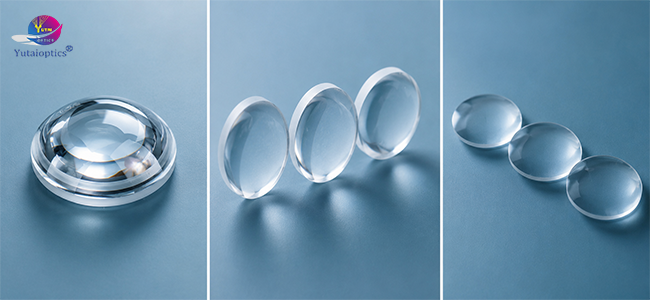
Yutai Optics: High-precision machining capability for calcium fluoride spherical lenses
I. Core Specifications of Finished Products
Yutai Optics achieves the following core specifications for spherical lenses made of calcium fluoride (CaF₂) material, within the aperture range of D10~100mm:
Aperture number N ≥ 0.5
Irregularity ΔN ≥ λ/10 (@632.8nm)
Surface quality better than 40-20 (US military standard MIL-PRF-13830B)
Center thickness tolerance ±0.05 mm, diameter tolerance ±0.02 mm
Supports various spherical structures such as plano-convex, biconvex, plano-concave, biconcave, and meniscus
Optional UV/IR antireflection coating, high reflectivity coating, or beam splitting coating
It is important to note that the combination of N ≥ 0.5 and ΔN ≥ λ/10 reflects a clear engineering approach: prioritizing the accuracy of the overall curvature (N ≥ 0.5), while providing a lower limit requirement of no less than λ/10 for local irregularities. This is not due to insufficient processing capabilities, but rather to precise matching for specific optical system requirements (such as high-tolerance illumination, non-imaging focusing, infrared detection windows, etc.).
II. Indicator Interpretation: Engineering Significance of N ≥ 0.5 and ΔN ≥ λ/10
In optical testing standards:
N (aperture number) reflects the deviation of the overall curvature of the lens from the ideal spherical surface. N ≥ 0.5 means that the overall surface shape deviation is controlled within ±0.25 aperture stops, which is a relatively stringent overall accuracy requirement.
ΔN (irregularity) reflects the degree of local surface shape undulation. Conventional high-precision optical systems prefer ΔN to be as small as possible (e.g., ≤λ/10), but in some systems, excessively high local flatness is neither necessary nor significantly increases costs.
ΔN ≥ λ/10 means that a local deviation not exceeding λ/10 is allowed. This provides a reasonable tolerance for the manufacturing process while avoiding an excessive pursuit of an "overly flat" surface shape. Yutai Optics can achieve stable mass production under this combination of indicators, balancing accuracy and cost.
Compared with common industry indicators: Most calcium fluoride lens processing uses N=2~5 and ΔN=λ/4~λ/2 as the standard delivery. High-precision optical components typically require N ≤ 1 and ΔN ≤ λ/10.
Yutai Optics' combination of N ≥ 0.5 and ΔN ≥ λ/10 significantly outperforms conventional levels in overall curvature accuracy (N is increased by 4~10 times), while providing a practical and controllable lower limit requirement for local flatness.
III. Comparison of Measured Data with Industry Standards
Taking a D30~80mm diameter calcium fluoride spherical lens as an example, the comparison between Yutai Optics and ordinary domestic processing levels is as follows:
IV. Typical Application Scenarios
The combination of N ≥ 0.5, ΔN ≥ λ/10, and surface quality better than 40-20 is suitable for the following scenarios:
Focusing or relay optics in infrared thermal imaging systems. In infrared thermal imaging systems (3-5μm and 8-12μm bands), focusing lenses and relay lenses require high overall curvature accuracy to ensure accurate focusing. However, they have relatively high tolerance for local surface undulations (ΔN), and ΔN ≥ λ/10 is sufficient. A surface quality better than 40-20 helps reduce scattering loss and improve the signal-to-noise ratio of the infrared detector. Typical aperture range is D20~80mm.
Large Aberration Tolerance Ultraviolet Illumination Optical Paths
In deep ultraviolet (e.g., 248nm, 193nm) illumination or exposure systems, some homogenizing, coupling, or relay lenses are located in optical path positions with large aberration tolerances. While local surface accuracy requirements are not high, the overall curvature (N ≥ 0.5) must be maintained to control beam direction. Calcium fluoride materials offer high transmittance in this wavelength range, and a surface area better than 40-20 can reduce the risk of ultraviolet-induced scattering and damage.
Beam Expanding or Collimating Systems for High-Power Lasers: Beam expanders and collimating lenses for high-power lasers prioritize overall surface shape to control the pointing stability and divergence angle of the emitted beam. Local irregularities ΔN ≥ λ/10 typically do not significantly affect the far-field spot quality. Excellent surface quality (better than 40-20) helps reduce the probability of laser damage and extend component lifespan.
For cost- and time-sensitive batch optical components, in some non-imaging or weak-imaging optical systems (such as industrial sensing, laser processing auxiliary optical paths, security monitoring, etc.), the combination of N ≥ 0.5 and better than 40-20 can meet the performance requirements. At the same time, a reasonable ΔN tolerance (≥ λ/10) reduces the processing difficulty and scrap rate, which is conducive to controlling costs and shortening the delivery cycle.
Other applicable scenarios
Wideband chromatic aberration correction lens (for use with other materials)
UV/IR detection window (for non-imaging or low-resolution imaging)
Beam shaping or transmission optics in laser processing systems
V. Summary of Core Competencies
Overall surface accuracy N ≥ 0.5: 4-8 times higher than industry standard
Irregularity ΔN ≥ λ/10: Precisely matches specific tolerance requirements, avoiding over-processing
Surface quality better than 40-20: Stable mass production, first pass rate ≥ 95%
Diameter coverage 10-100mm: Advantageous for medium and large diameters
Yield ≥ 85%: Stable output under high-specification conditions
Connectable to coating, testing, and assembly: One-stop solution
Yutai Optics achieves the following core specifications for spherical lenses made of calcium fluoride (CaF₂) material, within the aperture range of D10~100mm:
Aperture number N ≥ 0.5
Irregularity ΔN ≥ λ/10 (@632.8nm)
Surface quality better than 40-20 (US military standard MIL-PRF-13830B)
Center thickness tolerance ±0.05 mm, diameter tolerance ±0.02 mm
Supports various spherical structures such as plano-convex, biconvex, plano-concave, biconcave, and meniscus
Optional UV/IR antireflection coating, high reflectivity coating, or beam splitting coating
It is important to note that the combination of N ≥ 0.5 and ΔN ≥ λ/10 reflects a clear engineering approach: prioritizing the accuracy of the overall curvature (N ≥ 0.5), while providing a lower limit requirement of no less than λ/10 for local irregularities. This is not due to insufficient processing capabilities, but rather to precise matching for specific optical system requirements (such as high-tolerance illumination, non-imaging focusing, infrared detection windows, etc.).
II. Indicator Interpretation: Engineering Significance of N ≥ 0.5 and ΔN ≥ λ/10
In optical testing standards:
N (aperture number) reflects the deviation of the overall curvature of the lens from the ideal spherical surface. N ≥ 0.5 means that the overall surface shape deviation is controlled within ±0.25 aperture stops, which is a relatively stringent overall accuracy requirement.
ΔN (irregularity) reflects the degree of local surface shape undulation. Conventional high-precision optical systems prefer ΔN to be as small as possible (e.g., ≤λ/10), but in some systems, excessively high local flatness is neither necessary nor significantly increases costs.
ΔN ≥ λ/10 means that a local deviation not exceeding λ/10 is allowed. This provides a reasonable tolerance for the manufacturing process while avoiding an excessive pursuit of an "overly flat" surface shape. Yutai Optics can achieve stable mass production under this combination of indicators, balancing accuracy and cost.
Compared with common industry indicators: Most calcium fluoride lens processing uses N=2~5 and ΔN=λ/4~λ/2 as the standard delivery. High-precision optical components typically require N ≤ 1 and ΔN ≤ λ/10.
Yutai Optics' combination of N ≥ 0.5 and ΔN ≥ λ/10 significantly outperforms conventional levels in overall curvature accuracy (N is increased by 4~10 times), while providing a practical and controllable lower limit requirement for local flatness.
III. Comparison of Measured Data with Industry Standards
Taking a D30~80mm diameter calcium fluoride spherical lens as an example, the comparison between Yutai Optics and ordinary domestic processing levels is as follows:
|
Comparison items |
Industry standard |
Yutai Optics |
|
Aperture number N |
2~4 |
≥ 0.5 |
|
Irregularity ΔN |
λ/4 ~ λ/2 (or not controlled separately) |
≥ λ/10 (controlled within λ/10~λ/4) |
|
Surface quality |
60-40 (mainstream) / 40-20 (minority) |
Better than 40-20 (some can reach 20-10) |
|
High-specification yield (N≥0.5 and surface finish better than 40-20)
|
Approximately 40%~60% |
≥85% |
|
Stable processing diameter upper limit |
≤60mm |
100mm |
IV. Typical Application Scenarios
The combination of N ≥ 0.5, ΔN ≥ λ/10, and surface quality better than 40-20 is suitable for the following scenarios:
Focusing or relay optics in infrared thermal imaging systems. In infrared thermal imaging systems (3-5μm and 8-12μm bands), focusing lenses and relay lenses require high overall curvature accuracy to ensure accurate focusing. However, they have relatively high tolerance for local surface undulations (ΔN), and ΔN ≥ λ/10 is sufficient. A surface quality better than 40-20 helps reduce scattering loss and improve the signal-to-noise ratio of the infrared detector. Typical aperture range is D20~80mm.
Large Aberration Tolerance Ultraviolet Illumination Optical Paths
In deep ultraviolet (e.g., 248nm, 193nm) illumination or exposure systems, some homogenizing, coupling, or relay lenses are located in optical path positions with large aberration tolerances. While local surface accuracy requirements are not high, the overall curvature (N ≥ 0.5) must be maintained to control beam direction. Calcium fluoride materials offer high transmittance in this wavelength range, and a surface area better than 40-20 can reduce the risk of ultraviolet-induced scattering and damage.
Beam Expanding or Collimating Systems for High-Power Lasers: Beam expanders and collimating lenses for high-power lasers prioritize overall surface shape to control the pointing stability and divergence angle of the emitted beam. Local irregularities ΔN ≥ λ/10 typically do not significantly affect the far-field spot quality. Excellent surface quality (better than 40-20) helps reduce the probability of laser damage and extend component lifespan.
For cost- and time-sensitive batch optical components, in some non-imaging or weak-imaging optical systems (such as industrial sensing, laser processing auxiliary optical paths, security monitoring, etc.), the combination of N ≥ 0.5 and better than 40-20 can meet the performance requirements. At the same time, a reasonable ΔN tolerance (≥ λ/10) reduces the processing difficulty and scrap rate, which is conducive to controlling costs and shortening the delivery cycle.
Other applicable scenarios
Wideband chromatic aberration correction lens (for use with other materials)
UV/IR detection window (for non-imaging or low-resolution imaging)
Beam shaping or transmission optics in laser processing systems
V. Summary of Core Competencies
Overall surface accuracy N ≥ 0.5: 4-8 times higher than industry standard
Irregularity ΔN ≥ λ/10: Precisely matches specific tolerance requirements, avoiding over-processing
Surface quality better than 40-20: Stable mass production, first pass rate ≥ 95%
Diameter coverage 10-100mm: Advantageous for medium and large diameters
Yield ≥ 85%: Stable output under high-specification conditions
Connectable to coating, testing, and assembly: One-stop solution
Share this:


PREV : The Appropriate Positioning of K9 Optical Glass in Precision Optical Components NEXT : Aspherical lenses: eliminating spherical aberration and improving surface accuracy
TALK TO US 86-15584132290
Call us now!
86-15584132290Call us now!

ONLINE CHAT
 2433808388
2433808388