ISO9001 Certified Professional Manufacturer & Supplier of Optics
+86-0431-87911611 admin@ytoptics.com

Contact us
-
 Email: admin@ytoptics.com
-
 English Inquiry Support:
-
 Add: 2# Automotive InnovationPark,
City,Jilin Province, China
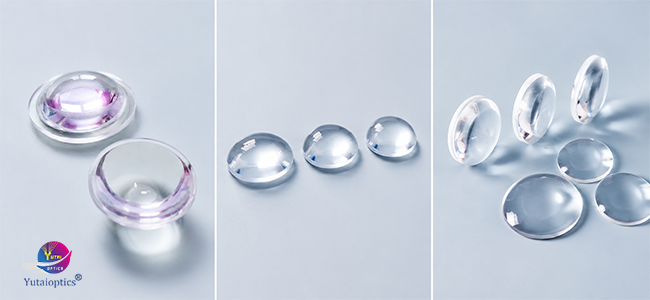
Aspherical lenses: eliminating spherical aberration and improving surface accuracy
I. What is spherical aberration?
When parallel light rays pass through a convex lens, ideally, all the rays should converge to the same point. However, a real spherical lens cannot achieve this. Light rays refract as they pass through the lens. According to the law of refraction, the larger the angle of incidence, the greater the refraction. On a spherical lens, the angle of incidence for rays at the edges of the lens is much larger than that for rays at the center. Therefore, the refraction of the edge rays is greater than that of the center rays.
As a result, the edge rays converge closer to the lens, while the center rays gradually converge further back. They never meet at the same point. What should be a sharp focal point becomes a diffuse spot of light. This phenomenon is called spherical aberration.
The mathematical root of spherical aberration lies in the geometric equations of a sphere. The expression for the sagitta of a sphere is: z = cr²1 + 1 − c²r², where c is the curvature (the reciprocal of the radius) and r is the radial distance. Expanding this expression into a Taylor series, the first term is a quadratic term, corresponding to ideal focusing; the subsequent fourth and sixth-order terms are the source of spherical aberration. The sphere itself determines that these higher-order terms are not zero.
Traditional methods for eliminating spherical aberration use a combination of multiple spherical mirrors. The spherical aberration signs of different mirrors can be opposite, canceling each other out. However, each additional mirror adds two more reflecting surfaces, introducing new light energy loss and stray light.
II. How aspherical lenses eliminate spherical aberration
The idea behind aspherical lenses is not to cancel spherical aberration, but to eliminate it altogether.
The problem with spherical lenses is that their curvature is uniform throughout. Aspherical lenses, on the other hand, make their curvature gradually change: one curvature at the center, gradually varying outwards, and then another curvature at the edges.
Specifically, if light rays are refracted too much at the edges, the curvature in the edge region is reduced, weakening its refractive power. If light rays are not refracted enough at the center, the curvature in the central region is increased. By controlling the curvature point by point, it is ensured that every ray of light incident from the center to the edge converges precisely to the same point after passing through the lens.
The expression for the spherical elevation of an aspherical lens is based on the spherical lens with added correction terms:
z = cr²1 + 1 − (1 + k)c²r² + A₄r₄ + A₆r₆ + A₈r₈ + ...
z = 1 + 1 − (1 + k)c²r²cr² + A₄r₄ + A₆r₆ + A₈r₈ + ...
where k is the conic constant, and A₄, A₆, and A₈ are higher-order aspherical coefficients. These parameters allow for the elimination of higher-order terms in the spherical expansion that contribute to spherical aberration.
In optical design software, a well-optimized aspherical lens can reduce on-axis spherical aberration to zero. In practical designs, a single aspherical lens often replaces three to four spherical lenses. For example, in a five- or six-element mobile phone lens structure, typically two or three elements are aspherical to achieve usable image quality within a few millimeters of thickness.
III. Surface Accuracy
Aspherical lenses eliminate spherical aberration based on theoretical calculations. However, theoretical accuracy does not equate to practical accuracy. During manufacturing, a key performance indicator determines the actual performance of an aspherical lens: surface shape accuracy.
1. What is Surface Shape Accuracy?
Surface shape accuracy is the deviation between the actual machined surface shape and the ideal design shape.
This deviation is holistic and macroscopic. It doesn't concern itself with micron-level polishing textures on the mirror surface, which fall under the category of roughness. It only cares about one thing: whether the overall contour of the mirror surface has been distorted.
For example, if the design requires an aspherical curve A, but the actual manufactured shape is B, the difference between B and A is the surface shape error. This difference is unevenly distributed across the entire mirror surface; some areas are higher, and some are lower.
2. How to Measure
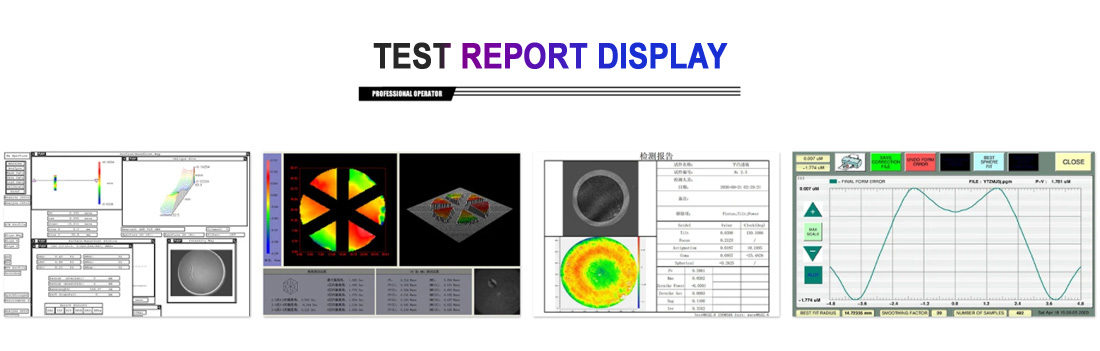
The tool for measuring surface shape accuracy is an interferometer, commonly a Fizeau interferometer or a phase-shifting interferometer.
The principle is that a standard reference beam is shone onto the mirror being measured. The reflected light interferes with the reference beam, forming interference fringes. The curvature and density of the interference fringes reflect the height difference between points on the mirror surface and the reference surface.
For aspherical lenses, a compensator is usually required, or a computational hologram is used to convert the standard spherical wavefront into a wavefront that matches the ideal shape of the aspherical surface. Without a compensator, the interference fringes will be too dense to be resolved. The measurement yields a surface shape error map of the entire aperture. The root mean square value or peak-to-valley value is directly calculated from this map; this is the quantitative indicator of surface shape accuracy. The unit is expressed in nanometers or fractions of wavelength, typically λ = 632.8 nm (the wavelength of a helium-neon laser).
3. What Happens When Surface Shape Accuracy is Substandard?
Surface shape errors directly damage wavefront quality.
When light waves pass through optical elements, the wavefront should maintain an ideal shape. If the mirror surface has surface shape errors, an additional optical path difference will be added to the reflected or transmitted wavefront. This optical path difference is the wavefront error.
Consequences of wavefront error:
Defocus: The overall curvature of the mirror is too large or too small, causing the focal point to shift.
Astigmatism: The curvature of the mirror is inconsistent in two perpendicular directions, producing astigmatic focal lines.
Coma: Asymmetric errors in the mirror surface cause off-axis points to produce comet-like tails.
These aberrations increase the point spread function. A small point of light that should be diffraction-limited becomes a large spot. The Strell ratio decreases. Image resolution is reduced.
The key point is: Spherical aberration eliminated in the software during the design phase can be brought back by surface shape accuracy issues in the form of other aberrations. The lens still uses the aspherical design, but its actual performance may be worse than that of a high-precision spherical lens.
4. Which Processes Determine Surface Shape Accuracy?
The quality of surface shape accuracy primarily depends on the forming and roughing stages:
Milling: A diamond grinding wheel mills the basic shape of the aspherical surface onto the blank. This step determines the overall framework of surface shape accuracy, with deviations typically on the order of micrometers.
CNC Grinding: Using finer abrasives, the surface gradually approaches the target shape, reducing deviations to sub-micrometer levels.
Rough Polishing: Further corrects macroscopic shape errors while reducing surface roughness to a level that can be addressed by subsequent fine polishing.
IV. The Relationship Between Spherical Aberration Elimination and Surface Accuracy
These two concepts belong to different stages, but together they determine the final performance of an aspherical lens.
V. Conclusion
The principle of aspherical lenses eliminating spherical aberration: The curvature of the spherical surface is changed from constant to gradually varying, controlling the deflection angle point by point, so that all light rays converge at the same point. The design tool is the aspherical coefficient.
The meaning of surface shape accuracy: The overall deviation between the actual manufactured shape and the designed shape. The measuring tool is an interferometer. Failure to meet the standard results in wavefront distortion, introducing aberrations, and reducing image resolution.
The relationship between the two: Design eliminates spherical aberration, manufacturing realizes surface shape accuracy. The former determines the upper limit, the latter safeguards the lower limit. The performance of an aspherical lens is the product of these two factors.
When parallel light rays pass through a convex lens, ideally, all the rays should converge to the same point. However, a real spherical lens cannot achieve this. Light rays refract as they pass through the lens. According to the law of refraction, the larger the angle of incidence, the greater the refraction. On a spherical lens, the angle of incidence for rays at the edges of the lens is much larger than that for rays at the center. Therefore, the refraction of the edge rays is greater than that of the center rays.
As a result, the edge rays converge closer to the lens, while the center rays gradually converge further back. They never meet at the same point. What should be a sharp focal point becomes a diffuse spot of light. This phenomenon is called spherical aberration.
The mathematical root of spherical aberration lies in the geometric equations of a sphere. The expression for the sagitta of a sphere is: z = cr²1 + 1 − c²r², where c is the curvature (the reciprocal of the radius) and r is the radial distance. Expanding this expression into a Taylor series, the first term is a quadratic term, corresponding to ideal focusing; the subsequent fourth and sixth-order terms are the source of spherical aberration. The sphere itself determines that these higher-order terms are not zero.
Traditional methods for eliminating spherical aberration use a combination of multiple spherical mirrors. The spherical aberration signs of different mirrors can be opposite, canceling each other out. However, each additional mirror adds two more reflecting surfaces, introducing new light energy loss and stray light.
II. How aspherical lenses eliminate spherical aberration
The idea behind aspherical lenses is not to cancel spherical aberration, but to eliminate it altogether.
The problem with spherical lenses is that their curvature is uniform throughout. Aspherical lenses, on the other hand, make their curvature gradually change: one curvature at the center, gradually varying outwards, and then another curvature at the edges.
Specifically, if light rays are refracted too much at the edges, the curvature in the edge region is reduced, weakening its refractive power. If light rays are not refracted enough at the center, the curvature in the central region is increased. By controlling the curvature point by point, it is ensured that every ray of light incident from the center to the edge converges precisely to the same point after passing through the lens.
The expression for the spherical elevation of an aspherical lens is based on the spherical lens with added correction terms:
z = cr²1 + 1 − (1 + k)c²r² + A₄r₄ + A₆r₆ + A₈r₈ + ...
z = 1 + 1 − (1 + k)c²r²cr² + A₄r₄ + A₆r₆ + A₈r₈ + ...
where k is the conic constant, and A₄, A₆, and A₈ are higher-order aspherical coefficients. These parameters allow for the elimination of higher-order terms in the spherical expansion that contribute to spherical aberration.
In optical design software, a well-optimized aspherical lens can reduce on-axis spherical aberration to zero. In practical designs, a single aspherical lens often replaces three to four spherical lenses. For example, in a five- or six-element mobile phone lens structure, typically two or three elements are aspherical to achieve usable image quality within a few millimeters of thickness.
III. Surface Accuracy
Aspherical lenses eliminate spherical aberration based on theoretical calculations. However, theoretical accuracy does not equate to practical accuracy. During manufacturing, a key performance indicator determines the actual performance of an aspherical lens: surface shape accuracy.
1. What is Surface Shape Accuracy?
Surface shape accuracy is the deviation between the actual machined surface shape and the ideal design shape.
This deviation is holistic and macroscopic. It doesn't concern itself with micron-level polishing textures on the mirror surface, which fall under the category of roughness. It only cares about one thing: whether the overall contour of the mirror surface has been distorted.
For example, if the design requires an aspherical curve A, but the actual manufactured shape is B, the difference between B and A is the surface shape error. This difference is unevenly distributed across the entire mirror surface; some areas are higher, and some are lower.
2. How to Measure
The tool for measuring surface shape accuracy is an interferometer, commonly a Fizeau interferometer or a phase-shifting interferometer.
The principle is that a standard reference beam is shone onto the mirror being measured. The reflected light interferes with the reference beam, forming interference fringes. The curvature and density of the interference fringes reflect the height difference between points on the mirror surface and the reference surface.
For aspherical lenses, a compensator is usually required, or a computational hologram is used to convert the standard spherical wavefront into a wavefront that matches the ideal shape of the aspherical surface. Without a compensator, the interference fringes will be too dense to be resolved. The measurement yields a surface shape error map of the entire aperture. The root mean square value or peak-to-valley value is directly calculated from this map; this is the quantitative indicator of surface shape accuracy. The unit is expressed in nanometers or fractions of wavelength, typically λ = 632.8 nm (the wavelength of a helium-neon laser).
3. What Happens When Surface Shape Accuracy is Substandard?
Surface shape errors directly damage wavefront quality.
When light waves pass through optical elements, the wavefront should maintain an ideal shape. If the mirror surface has surface shape errors, an additional optical path difference will be added to the reflected or transmitted wavefront. This optical path difference is the wavefront error.
Consequences of wavefront error:
Defocus: The overall curvature of the mirror is too large or too small, causing the focal point to shift.
Astigmatism: The curvature of the mirror is inconsistent in two perpendicular directions, producing astigmatic focal lines.
Coma: Asymmetric errors in the mirror surface cause off-axis points to produce comet-like tails.
These aberrations increase the point spread function. A small point of light that should be diffraction-limited becomes a large spot. The Strell ratio decreases. Image resolution is reduced.
The key point is: Spherical aberration eliminated in the software during the design phase can be brought back by surface shape accuracy issues in the form of other aberrations. The lens still uses the aspherical design, but its actual performance may be worse than that of a high-precision spherical lens.
4. Which Processes Determine Surface Shape Accuracy?
The quality of surface shape accuracy primarily depends on the forming and roughing stages:
Milling: A diamond grinding wheel mills the basic shape of the aspherical surface onto the blank. This step determines the overall framework of surface shape accuracy, with deviations typically on the order of micrometers.
CNC Grinding: Using finer abrasives, the surface gradually approaches the target shape, reducing deviations to sub-micrometer levels.
Rough Polishing: Further corrects macroscopic shape errors while reducing surface roughness to a level that can be addressed by subsequent fine polishing.
IV. The Relationship Between Spherical Aberration Elimination and Surface Accuracy
These two concepts belong to different stages, but together they determine the final performance of an aspherical lens.
|
Comparison Dimensions |
Eliminate Spherical Aberration |
Surface Accuracy |
|
Stage |
Optical design |
Optical manufacturing
|
|
Core Issues |
Can light rays intersect at the same point |
Is the shape of the mirror deviating from the design |
|
Implementation |
Adjusting curvature distribution and aspherical coefficient |
Controlling machining deviations and error compensation |
|
Evaluation methods |
Ray tracing, point plot |
Interferometer measurement, surface error diagram |
|
Typical Indicators |
RMS radius and wavefront error of point plot |
Surface shape PV value, surface shape deviation in nanometers |
|
Failure performance |
Fog of focus, resolution not up to standard |
Aberration introduction, Strell ratio decrease |
|
Decision maker |
Optical Design Engineer |
Cold working process engineer |
V. Conclusion
The principle of aspherical lenses eliminating spherical aberration: The curvature of the spherical surface is changed from constant to gradually varying, controlling the deflection angle point by point, so that all light rays converge at the same point. The design tool is the aspherical coefficient.
The meaning of surface shape accuracy: The overall deviation between the actual manufactured shape and the designed shape. The measuring tool is an interferometer. Failure to meet the standard results in wavefront distortion, introducing aberrations, and reducing image resolution.
The relationship between the two: Design eliminates spherical aberration, manufacturing realizes surface shape accuracy. The former determines the upper limit, the latter safeguards the lower limit. The performance of an aspherical lens is the product of these two factors.
Share this:


PREV : Yutai Optics: High-precision machining capability for calcium fluoride spherical lenses NEXT : Precision optical component planar beveling technology
TALK TO US 86-15584132290
Call us now!
86-15584132290Call us now!

ONLINE CHAT
 2433808388
2433808388