ISO9001 Certified Professional Manufacturer & Supplier of Optics
+86-0431-87911611 admin@ytoptics.com

Contact us
-
 Email: admin@ytoptics.com
-
 English Inquiry Support:
-
 Add: 2# Automotive InnovationPark,
City,Jilin Province, China
Do laser-grade and infrared-grade ZnSe lenses perform differently in use?
The answer is yes, and this choice directly affects the lens’s lifespan and stability within the system—not just its initial optical performance. The core difference between the two lies not in whether they “allow light to pass through,” but in the material’s degree of laser energy absorption, which determines whether the lens will overheat, deform, or even be damaged.
I. Core Difference: Absorption Coefficient Is Everything
The distinction between laser-grade and infrared-grade zinc selenide essentially comes down to different tolerances for the absorption coefficient.
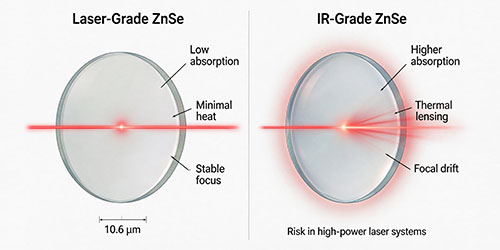
Laser-grade materials are designed for high-power laser systems (such as CO₂ laser cutting and marking), which require extremely low absorption rates. This is because even minimal absorption, when subjected to high power density, converts into heat, causing the “thermal lensing effect”—where the lens’s refractive index changes and its surface profile undergoes slight deformation due to heat, resulting in a larger focal spot or positional drift, which directly degrades processing quality. If absorption is even slightly higher, the coating or substrate may be damaged by thermal stress. Industry data indicates that precision-grade ZnSe can achieve an absorption coefficient of <0.0005 cm at 10.6 μm, which is the typical standard for laser-grade materials.
Infrared-grade materials are designed for applications such as thermal imaging, infrared temperature measurement, and spectral analysis. These applications do not involve high-power lasers passing through the lenses, and the lenses themselves are not tasked with “withstanding energy”; therefore, the requirements for absorption are much less stringent. The infrared grade focuses more on transmittance and scattering levels within specific infrared bands rather than extremely low absorption. Some suppliers explicitly point out that thermal imaging applications can use materials that are less expensive than laser-grade ones, since absorption is not a decisive factor in these applications.
I. Core Difference: Absorption Coefficient Is Everything
The distinction between laser-grade and infrared-grade zinc selenide essentially comes down to different tolerances for the absorption coefficient.
Laser-grade materials are designed for high-power laser systems (such as CO₂ laser cutting and marking), which require extremely low absorption rates. This is because even minimal absorption, when subjected to high power density, converts into heat, causing the “thermal lensing effect”—where the lens’s refractive index changes and its surface profile undergoes slight deformation due to heat, resulting in a larger focal spot or positional drift, which directly degrades processing quality. If absorption is even slightly higher, the coating or substrate may be damaged by thermal stress. Industry data indicates that precision-grade ZnSe can achieve an absorption coefficient of <0.0005 cm at 10.6 μm, which is the typical standard for laser-grade materials.
Infrared-grade materials are designed for applications such as thermal imaging, infrared temperature measurement, and spectral analysis. These applications do not involve high-power lasers passing through the lenses, and the lenses themselves are not tasked with “withstanding energy”; therefore, the requirements for absorption are much less stringent. The infrared grade focuses more on transmittance and scattering levels within specific infrared bands rather than extremely low absorption. Some suppliers explicitly point out that thermal imaging applications can use materials that are less expensive than laser-grade ones, since absorption is not a decisive factor in these applications.
II. Consequences of Using the Wrong Grade
What happens if an infrared-grade lens is installed in a high-power CO₂ laser optical path?
As the lens absorbs laser energy, its temperature rises, initially manifesting as a thermal lensing effect: the focal length drifts, causing a spot originally focused at 0.1 mm to spread out, resulting in a wider cutting seam and poorer edge quality. If the power is high enough or the absorption is significant enough, thermal stress may exceed the tolerance limits of the material or coating, causing the coating to crack or the substrate to shatter. Conversely, using laser-grade lenses for standard infrared thermal imaging poses no performance issues, but it amounts to paying extra for “low absorption” specifications that aren’t needed, resulting in poor cost-effectiveness.
III. How to Determine Which Grade Your Project Needs
Ask yourself one key question: Is the lens in the optical path and does it need to “withstand” laser power?
If the answer is yes—that is, if the lens is used for focusing, reflecting, or as a window for a CO₂ laser, and the laser power is not in the milliwatt range (as in an alignment beam) but rather in the watt range or higher for processing or medical applications—you must select a laser-grade lens. In this case, you should also confirm whether the supplier can provide laser damage threshold (LIDT) data and whether the coating is optimized for 10.6 μm. For kilowatt-level applications, even higher-grade precision-grade materials paired with high-LIDT coatings are required.
If the answer is no—the lens is only used to receive infrared radiation, for thermal imaging, or for spectral measurements, and no high-power laser passes through it in the optical path—infrared-grade is sufficient, and there is no need to pay a premium for the low absorption specifications of laser-grade lenses.
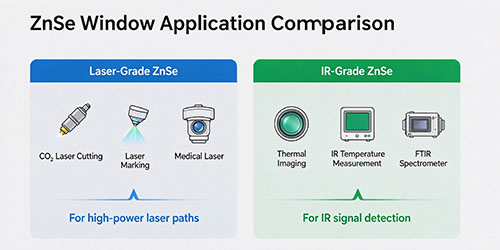
Simply put: Laser-grade lenses are designed to “handle power,” while infrared-grade lenses are designed to “detect signals.” The two may be marginally interchangeable in thermal imaging applications (though laser-grade performance is superior but represents a waste of resources), but in laser optical paths, infrared-grade lenses cannot replace laser-grade lenses.
What happens if an infrared-grade lens is installed in a high-power CO₂ laser optical path?
As the lens absorbs laser energy, its temperature rises, initially manifesting as a thermal lensing effect: the focal length drifts, causing a spot originally focused at 0.1 mm to spread out, resulting in a wider cutting seam and poorer edge quality. If the power is high enough or the absorption is significant enough, thermal stress may exceed the tolerance limits of the material or coating, causing the coating to crack or the substrate to shatter. Conversely, using laser-grade lenses for standard infrared thermal imaging poses no performance issues, but it amounts to paying extra for “low absorption” specifications that aren’t needed, resulting in poor cost-effectiveness.
III. How to Determine Which Grade Your Project Needs
Ask yourself one key question: Is the lens in the optical path and does it need to “withstand” laser power?
If the answer is yes—that is, if the lens is used for focusing, reflecting, or as a window for a CO₂ laser, and the laser power is not in the milliwatt range (as in an alignment beam) but rather in the watt range or higher for processing or medical applications—you must select a laser-grade lens. In this case, you should also confirm whether the supplier can provide laser damage threshold (LIDT) data and whether the coating is optimized for 10.6 μm. For kilowatt-level applications, even higher-grade precision-grade materials paired with high-LIDT coatings are required.
If the answer is no—the lens is only used to receive infrared radiation, for thermal imaging, or for spectral measurements, and no high-power laser passes through it in the optical path—infrared-grade is sufficient, and there is no need to pay a premium for the low absorption specifications of laser-grade lenses.
Simply put: Laser-grade lenses are designed to “handle power,” while infrared-grade lenses are designed to “detect signals.” The two may be marginally interchangeable in thermal imaging applications (though laser-grade performance is superior but represents a waste of resources), but in laser optical paths, infrared-grade lenses cannot replace laser-grade lenses.
The selection of zinc selenide (ZnSe) lenses of different grades directly affects the stability, processing performance, and service life of the entire infrared and laser system.
Yutai Optics offers infrared optical components such as laser-grade and infrared-grade ZnSe windows and focusing lenses. If you are unsure which grade of ZnSe lens to choose for your project, please feel free to contact us at any time with parameters such as laser power and operating wavelength, and we will help you find the right solution.
FAQ
1. Q: If the transmittance is similar, can infrared-grade ZnSe be used as a cost-saving alternative to laser-grade ZnSe?
A: No. While differences in absorption may not be evident in static transmittance tests, sustained heat generation at high power levels poses a significant risk of thermal lensing and lens damage.
2. Q: Can laser-grade ZnSe be used as a window for infrared thermal imagers?
A: The optical performance is perfectly fine, but the material carries a high premium, making it over-specified for most applications and not budget-friendly.
3. Q: When purchasing, aside from the grade, what other parameters should I confirm with Yutai Optics?
A: The 10.6 μm absorption coefficient, LIDT (Laser-Induced Damage Threshold), surface profile, coating type, parallelism, and cleanliness.
Share this:


TALK TO US 86-15584132290
Call us now!
86-15584132290Call us now!

ONLINE CHAT
 2433808388