
-
 Email: admin@ytoptics.com
-
 English Inquiry Support:
-
 Add: 2# Automotive InnovationPark,
City,Jilin Province, China
Fused Silica Step Windows: A Selection Guide for Optical and Vacuum Systems
For optical and mechanical design engineers selecting viewing windows for vacuum chambers, laser equipment, and semiconductor process equipment, standard Fused Silica windows often pose challenges during installation and sealing. Fused Silica stepped glass windows, however, offer a practical, integrated solution. What is a stepped optical window? What are the advantages of Fused silica stepped windows? Can Fused silica windows be used in vacuum and high-temperature environments? Can the stepped profile and anti-reflective coatings be customized? This article will answer these questions and explain the scenarios in which you should select Fused silica windows for your optical systems.
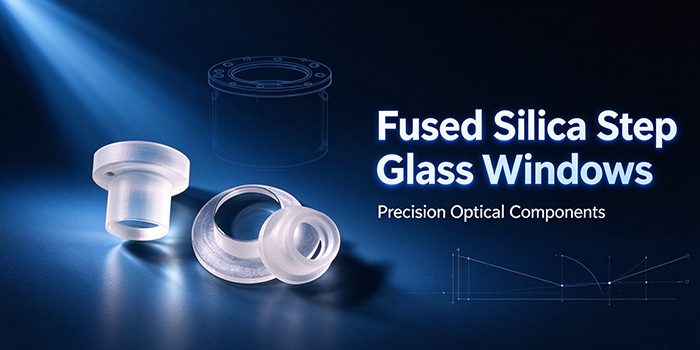
Fused silica stepped glass windows (also known as Fused silica stepped optical windows) are precision-polished Fused silica components with an integrated stepped/shouldered structure machined along their outer edges. Traditional flat optical windows require additional gaskets or clamping rings for positioning; in contrast, stepped windows feature built-in positioning shoulders. Their monolithic design enables flush mounting and repeatable positioning, ensuring that sealing gaskets provide a reliable seal between optical components, vacuum flanges, and instrument housings. Yutai Optics can manufacture these windows using JGS1, JGS2, and JGS3 UV-grade Fused silica as well as Corning 7980 substrate, supporting custom circular, square, rectangular, and irregular shapes. The step depth, shoulder width, outer diameter, and light-transmitting aperture can all be customized according to the customer’s CAD drawings.
Key Advantages of Fused Silica Stepped Optical Windows
1. Integrated mechanical positioning reduces assembly errors
The machined shoulder provides axial fixation during installation. Engineers no longer need to worry about issues common with standard flat windows, such as inconsistent spacer thickness or optical path misalignment. For laser beam transmission, in-situ spectral monitoring, and wafer inspection optical systems, repeatable and stable optical positioning directly determines detection accuracy.
2. Excellent thermal and chemical stability
Fused silica has an extremely low coefficient of thermal expansion and can operate continuously in environments exceeding 1000°C, while resisting corrosion from most acids and plasma byproducts. Compared to borosilicate glass, Fused silica maintains high transmittance across the deep ultraviolet, visible, and near-infrared wavelength ranges (180 nm–2500 nm). It does not deform under rapid thermal cycling in process chambers, making it suitable for high-temperature and plasma environments.
3. Reliable Vacuum Sealing and Low Outgassing Characteristics
The stepped shoulders fit uniformly against the sealing gasket, evenly distributing the clamping force, reducing stress concentration, and minimizing the risk of glass fracture during tightening. This makes it suitable for high-vacuum and ultra-high-vacuum (UHV) systems with low leak rates. High-purity Fused silica has extremely low outgassing rates, meeting the stringent requirements of cleanrooms and semiconductor chambers.
4. Customizable Optical Coatings
Yutai Optics can apply anti-reflective (AR) coatings, broadband anti-reflective coatings, or coatings for specific wavelengths to either one or both sides. Anti-reflective coatings reduce surface reflection loss and increase the laser damage threshold, making them suitable for applications such as UV lasers, Raman spectroscopy, and UV-visible spectroscopy. Surface quality options range from the standard 40-20 scratch-and-pitting to the high-end 10-5 scratch-and-pitting, with flatness achievable up to λ/20 (customizable upon request).
Major Applications
Semiconductor Process Equipment
Fused silica stepped windows are used as observation windows for the chambers of PVD, CVD, plasma etching, and MOCVD equipment. While maintaining vacuum and resisting corrosive plasma residues, they enable real-time optical monitoring, end-point detection, and non-contact temperature measurement. The stepped design simplifies flange assembly in wafer process chambers.
Laser and Photonics Systems
High-power UV laser equipment, laser ablation systems, UV curing systems, and beam monitoring instruments utilize Fused silica stepped windows as protective beam windows. The one-piece stepped design ensures installation stability during thermal cycling, preventing beam drift caused by component displacement.
Vacuum Chambers and Research Instruments
Synchrotron beamlines, vacuum systems for materials testing, and analytical spectrometers use stepped Fused silica observation windows as optical path windows. The gaskets ensure uniform contact, maintaining stable vacuum performance during repeated vacuum cycling.
Medical and Analytical Instruments
Fluorescence detectors, biochemical analyzers, and optical diagnostic equipment utilize miniaturized stepped Fused silica windows. These compact, high-precision windows maintain the internal sealed optical path of precision diagnostic equipment.
Why Choose Yutai Optics as Your Supplier of Stepped Fused Silica Windows?
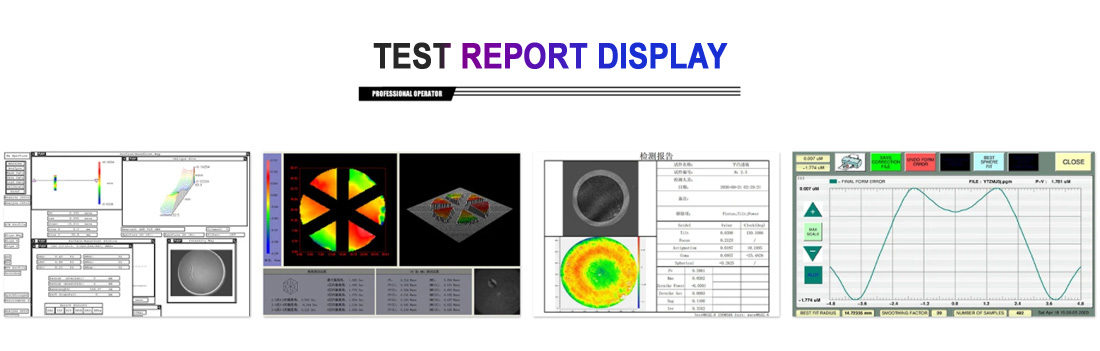
Yutai Optics specializes in custom-made precision optical components, including stepped Fused silica windows, spherical lenses, and laser windows. With in-house CNC grinding, double-sided polishing, and coating facilities, we maintain full in-house control over the entire process—from blank cutting, step machining, polishing, and coating to final metrological testing. We provide comprehensive inspection reports covering surface quality, flatness, parallelism, and dimensional tolerances. We support sample prototyping, small-batch, and high-volume production, and our export products are packaged in a cleanroom environment.
Whether you need standard, off-the-shelf stepped Fused silica observation windows or fully customized Fused silica stepped windows for semiconductor, laser, or vacuum equipment, our team of optical engineers can assess your optical and mechanical requirements and provide professional product selection recommendations. Please contact Yutai Optics to discuss your project needs and request a quote.
Frequently Asked Questions:
Question 1: What is the difference between a stepped window and a standard flat optical window?
Standard flat windows have uniform thickness and require additional shims for positioning. Stepped windows feature a machined shoulder, integrating positioning and sealing into a single unit. This reduces the number of parts in the bill of materials, shortens assembly time, and improves positioning consistency.
Question 2: Can Yutai Optics customize the step dimensions and shape?
Yes. The step width, step depth, aperture, outer contour, and total thickness can all be customized. We support circular, rectangular, and custom-shaped machining. You can provide drawings or specifications, and we will provide a quote and produce sample prototypes.
Question 3: Can step-type Fused silica windows be coated with anti-reflective coatings?
Absolutely. We can apply single-sided or double-sided anti-reflective coatings tailored for the UV, visible, and near-infrared wavelength bands. The coatings offer excellent durability and meet laser damage resistance requirements.
Question 4: Are Fused silica stepped windows suitable for ultra-high vacuum (UHV) applications?
High-purity JGS1 Fused silica stepped windows have an extremely low outgassing rate. Combined with edge chamfering and stress-relief treatment, they are widely used as ultra-high vacuum observation windows.
Question 5: How can window breakage be prevented during installation?
Uneven stress distribution and microcracks at the edges are the primary causes of breakage. Yutai Optics offers edge chamfering and stress-relief treatment. It is recommended to apply uniform torque when tightening the flange, use flexible gaskets, and avoid subjecting the Fused silica window to concentrated point loads.


 86-15584132290
Call us now!

 2433808388