
-
 Email: admin@ytoptics.com
-
 English Inquiry Support:
-
 Add: 2# Automotive InnovationPark,
City,Jilin Province, China
What is the difference between concave and convex optical lenses?
In geometric optics, concave and convex lenses are the two most fundamental and essential optical elements. Whilst their structures appear to be opposite, they each play a distinct and irreplaceable role in the control of light. A correct understanding of the fundamental differences between the two is the first step in optical system design. Changchun Yutai Optical Components Co., Ltd., with its deep expertise in the field of precision optical components, has systematically outlined the structural differences, optical principles and application areas of concave and convex lenses, with the aim of providing professional guidance for your project selection.
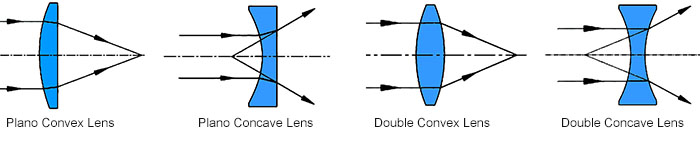
Structural Distinctions: The True Difference Lies in Thickness
The most obvious distinction between convex and concave lenses lies in their geometric shape. A convex lens is thicker at the centre and thinner at the edges; depending on the curvature of its two surfaces, it can be classified into three types: biconvex, plano-convex and concavo-convex (crescent-shaped convex lenses). It resembles a ‘round disc bulging in the middle’ and is capable of ‘converging’ parallel rays to a single point. In contrast, a concave lens is thinner at the centre and thicker at the edges, comprising structures such as double-concave, plano-concave and convex-concave (crescent-shaped concave lenses). It is akin to a ‘disc with a hollow centre’, capable of causing parallel rays of light to ‘divergent’.
This seemingly simple difference in thickness actually determines the fundamental distinction in the optical properties of the two.
Optical Essence: The Contrast Between Convergence and Divergence
A convex lens has a converging effect on light rays. Light rays incident parallel to the principal axis converge at a single point—the real focus (F)—after undergoing two refractions through the lens. As the light rays actually pass through this point, a convex lens is also known as a ‘converging lens’. In terms of imaging, the imaging behaviour of a convex lens varies richly depending on the object distance: when the object is beyond twice the focal length, a real, inverted and reduced image is formed (as in a camera); when the object is at twice the focal length, a real, inverted and life-size image is formed; when the object is between the focal length and twice the focal length, a real, inverted and magnified image is formed (as in a projector); and when the object is within the focal length, a virtual, erect and magnified image is formed (as in a magnifying glass). This characteristic makes the convex lens the core component of the vast majority of imaging systems.
In contrast, a concave lens causes light rays to diverge. When parallel light rays are refracted by a concave lens, they spread outwards, and their reverse extensions converge at a point on the same side as the light source—that is, the virtual focal point. As the rays do not actually pass through this point, a concave lens is also known as a ‘diverging lens’. At any object distance, a concave lens can only form an upright, reduced virtual image, and its imaging capability is relatively limited. This ‘reducing’ characteristic makes it the ideal choice for correcting myopia—by diverging the light in advance, the focal point in front of the retina is shifted backwards onto the retina, thereby restoring clear vision.
Fields of Application: Distinct Optical Roles
Based on the optical properties described above, the applications of these two types of lenses are highly differentiated. Convex lenses are widely used in magnifying glasses, microscope objectives and eyepieces, telescopes, camera and video camera lenses, projectors, condenser lenses, and spectacles for correcting hyperopia and presbyopia, performing the core functions of converging light and magnifying images. Concave lenses, on the other hand, are primarily used in spectacles for correcting myopia—the lenses worn by nearly half the world’s population for this purpose are based on concave lenses as their fundamental optical unit. Furthermore, concave lenses play an indispensable role in the eyepieces of Galilean telescopes, certain beam-expansion systems and optical path compensation devices.
It is worth noting that in high-precision optical systems, convex and concave lenses are often used in combination to form complex lens assemblies, enabling the simultaneous achievement of multiple objectives such as magnification, correction of aberrations and control of chromatic dispersion. Classic designs such as double-Gauss objectives and telecentric lenses are all prime examples of the exquisite coordination between these two types of lenses.
|
Comparison |
Convex lens |
Concave lens |
|
Focal power |
Positive focal power (converging lens) |
Negative focal power (diverging lens) |
|
Imaging characteristics |
Can produce real or virtual images; can magnify or reduce |
Can only produce an upright, reduced virtual image; cannot produce a real image on its own |
|
Optical path characteristics |
Parallel incident rays converge towards the optical axis after refraction, forming a real focal point |
Parallel incident rays diverge after refraction, forming a virtual focus |
|
Common materials |
BK7, fused silica, ZnSe (infrared), etc. |
BK7, fused silica, ZnSe (infrared), etc. |
|
Typical applications |
Microscopes, telescopes, camera lenses, projectors, hyperopic spectacles |
Myopic spectacles, eyepieces for Galilean telescopes, certain beam-expansion systems |
|
Coatings |
Primarily anti-reflection (AR) coatings |
Primarily anti-reflection (AR) coatings |
Yutai Optics: Pioneers in Precision Lens Manufacturing
Changchun Yutai Optics Co.,Ltd. is a manufacturer with ISO9001 certification. We are specialized in high-performance optical components include lens, mirrors, filters, windows and prisms which are specified by customers. Yutai’s items are widely used in imaging, defense, medical, laser and industry market.
As a fast-growing supplier in optics, Yutai Optics has quickly established itself as a leader in optical components with advanced technology and quality control ability as Yutai aims to provide professional service and good quality items to meet customers' request. Yutai has already established long-term cooperative relation with many powerful companies all over the world.
Whether you require high-precision convex lenses and converging optical systems, or concave lenses and diverging optical path designs, Yutai Optics can provide customised solutions from prototyping to mass production. Please feel free to call or visit our company for further enquiries; we will utilise our professional craftsmanship to create your ideal optical components.


NEXT : [7D11] The 27th China International Optoelectronic Exposition
 86-15584132290
Call us now!

 2433808388