ISO9001 Certified Professional Manufacturer & Supplier of Optics
+86-0431-87911611 admin@ytoptics.com

Contact us
-
 Email: admin@ytoptics.com
-
 English Inquiry Support:
-
 Add: 2# Automotive InnovationPark,
City,Jilin Province, China
Coating Solutions for Right-Angle Prisms — Determined by Your Application
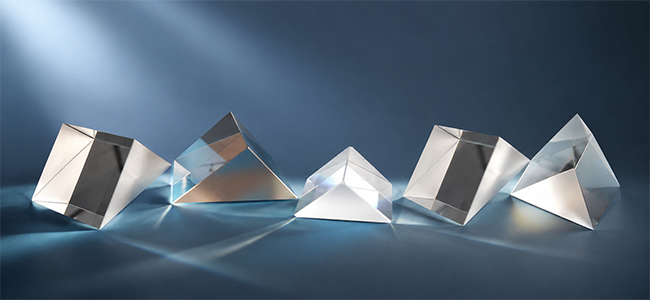
The same right-angle prism requires completely different coating schemes when used in a LiDAR receiver versus a periscope camera module. Furthermore, even for the identical function of achieving a 90° beam turn, the choice between relying on total internal reflection (TIR) and applying a metallic coating ultimately depends on your polarization control requirements.
1.One Table, Four Basic Solutions at a Glance
Scheme B is the first choice for the vast majority of applications. However, when it comes to specific industry scenarios, the selection tends to shift toward Scheme C or D. Let's break this down case by case.
Scenario 1: Optical Path Folding in LiDAR Receivers
The receiving system of a LiDAR typically requires folding the return optical path to minimize the overall footprint. In this application, the right-angle prism acts as a "90° folding mirror" — light enters through one right-angle face, reflects off the hypotenuse, and exits through the other right-angle face.
Recommended Scheme: B
Why this approach?
905 nm falls in the near-infrared band. If the right-angle faces are left uncoated, each surface introduces a reflection loss of approximately 4%, resulting in nearly 8% total energy loss across the two faces. With AR coating @ 905 nm, the reflectance per surface can be reduced to below 0.5%. As for the hypotenuse, total internal reflection (TIR) achieves 100% reflectivity in theory, so no coating is required.
What should be noted?
TIR imposes a strict requirement on the incident angle. For BK7 material, the critical angle is approximately 41.6°. In a right-angle prism, the light strikes the hypotenuse at 45°, which satisfies the condition. However, during TIR, the P-polarization and S-polarization undergo different phase shifts. If your system involves polarization control — for instance, when used in conjunction with polarization beam splitting components — this phase change must be taken into account in the system design. If polarization is not a concern, this scheme can be adopted as-is.
Scenario 2: Polarization Beam Splitting at the LiDAR Transmitter End
In coaxial LiDAR architectures, the transmitted and received beams share the same optical path. In this case, right-angle prisms are typically used in pairs, with a polarization beam splitting (PBS) coating applied between the hypotenuse faces to separate the transmitted and return light.
Recommended Scheme: PBS coating on the hypotenuse, AR coating @ 905 nm on the right-angle faces.
Why this approach?
Here, the hypotenuse no longer acts as a "reflector" but as a polarization beam splitter. Incident linearly polarized light (e.g., P-polarization) is transmitted, while S-polarization is reflected — or vice versa, depending on the optical path design. The key performance metrics are extinction ratio (typically required to be >1000:1) and transmission/reflection efficiency.
What should be noted?
The performance of PBS coatings is highly angle-sensitive and is typically designed for operation at a 45° incident angle. Angular deviations exceeding ±2° will significantly degrade the splitting ratio. In addition, the pulsed laser power at 905 nm can be considerably high, so the damage threshold of the coating must match the laser parameters. Please be sure to provide your laser power and pulse width information.
Scenario 3: Periscope Cameras and Endoscopes
The core requirement for this type of imaging system is not "high reflectivity," but rather "clean image plane." Ghost images and stray light are the arch-enemies of imaging quality. Especially in compact optical systems, a single residual reflection from a prism surface can produce a detectable ghost image.
Recommended Scheme: Scheme B (Broadband AR version)
Why this approach?
Visible light imaging systems need to cover the entire visible spectrum, so the right-angle faces must be coated with a broadband AR coating rather than a single-wavelength AR coating. Broadband coatings are more challenging to design — they must keep the average reflectance below 0.5% across the 400–700 nm range. As for the hypotenuse, TIR provides a "coating-free" 100% reflection that introduces no additional scattering from the coating itself, which is actually beneficial for stray light suppression.
What should be noted?
The residual reflectance of a broadband AR coating is not uniform across different wavelengths. If reflectance is relatively high in a certain band, ghost images may appear at that wavelength. A well-designed coating will focus optimization around 550 nm — the wavelength to which the human eye is most sensitive — while also balancing performance across the entire visible band. If you are using an RGB three-color sensor, we can also perform multi-point balanced optimization specifically for R (625 nm), G (530 nm), and B (460 nm).
Scenario 4: Industrial Security and Outdoor Surveillance
Outdoor equipment is exposed to temperature fluctuations, humidity, salt spray, and dust. The coating must be considered not only for optical performance but also for environmental durability.
Recommended Scheme: Scheme B + Hard Coating
Why this approach?
Outdoor applications impose explicit requirements on coating adhesion, hardness, and weatherability. Conventional AR coatings may delaminate under humid and hot conditions, so ion-assisted deposition (IAD) is required to improve film density and adhesion. Additionally, a hydrophobic and oleophobic top layer is applied to prevent contamination and facilitate cleaning.
What should be noted?
When the prism is used as an optical window, although the hypotenuse is "uncoated," if the prism is mounted on the exterior of the device and the hypotenuse is directly exposed to the environment, its scratch resistance and ease of cleaning must still be considered. If the prism is installed inside the device with proper sealing, then only the weatherability of the right-angle faces needs to be addressed.
Scenario 5: General Laboratory or Prototype Verification
During the prototyping phase, many engineers prefer to "get the optical path working first." The coating requirement is simply "good enough, cost first."
Recommended Scheme: Scheme A or single-layer MgF₂ AR coating
Why this approach?
Scheme A, with no coating at all, offers the lowest cost and fastest delivery. TIR at the hypotenuse provides 100% reflection, while the right-angle faces rely on the glass's natural transmission (~96% per surface), which is sufficient for optical path verification. If slightly higher transmission is desired, a single-layer MgF₂ coating can be applied to the two right-angle faces — this is the simplest AR solution, reducing reflectance at the design wavelength to approximately 1.5%.
What should be noted?
Uncoated right-angle faces are prone to scratching. Finger cots and gentle handling are required during operation. Additionally, if the prototype is ultimately intended for mass production, it is advisable to evaluate the coating scheme required for the final application in advance, so as to avoid optical path parameter changes caused by coating modifications later on.
2. Quick Selection by Application Scenario
3. Three Questions Before Selection
There is no "best" coating scheme for right-angle prisms — only the "most suitable" one. Before making your selection, ask yourself these three questions:
What is the prism used for? Optical path folding? Polarization beam splitting? Retroreflection?
Which wavelength band? Single wavelength or broadband?
Is the system polarization-sensitive? Does it involve interferometry, polarization detection, or PBS components?
Once you have answers to these three questions, the coating scheme becomes essentially clear.
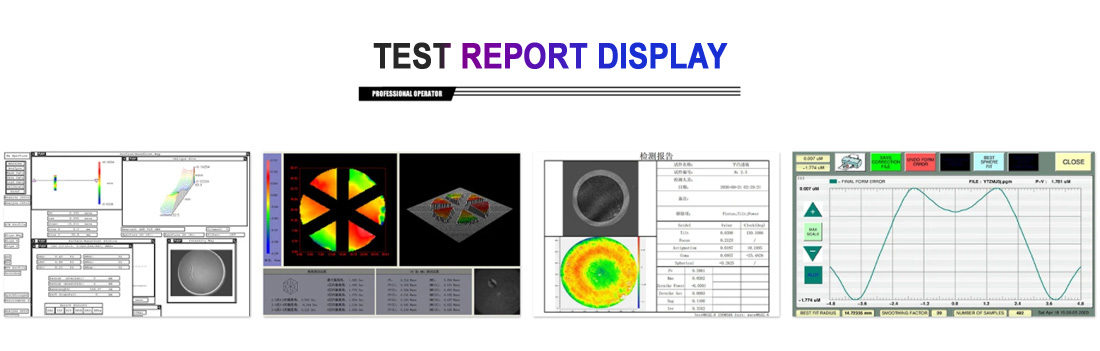
If you are unsure, feel free to contact us at any time: admin@ytoptics.com. Our professional optical engineers are ready to assist you with selection and coating design, and we provide measured spectral curves and inspection reports with every shipment.
1.One Table, Four Basic Solutions at a Glance
|
Scheme |
Hypotenuse Treatment |
Right-Angle Faces Treatment |
Key Features |
|
A |
Uncoated (Total Internal Reflection) |
Uncoated |
Lowest cost, 100% theoretical reflectivity, but surfaces are prone to scratching |
|
B |
Uncoated (Total Internal Reflection) |
AR-Coated |
Most common solution — balances high reflectivity and high transmission |
|
C |
Metallic Reflective Coating |
AR-Coated (optional) |
Stable polarization state, ~96% reflectivity, large angular tolerance |
|
D |
Dielectric Reflective Coating |
AR-Coated |
>99.5% reflectivity, high damage threshold, angle-sensitive |
Scheme B is the first choice for the vast majority of applications. However, when it comes to specific industry scenarios, the selection tends to shift toward Scheme C or D. Let's break this down case by case.
Scenario 1: Optical Path Folding in LiDAR Receivers
The receiving system of a LiDAR typically requires folding the return optical path to minimize the overall footprint. In this application, the right-angle prism acts as a "90° folding mirror" — light enters through one right-angle face, reflects off the hypotenuse, and exits through the other right-angle face.
Recommended Scheme: B
|
Surface |
Treatment |
|
Two right-angle faces |
AR-coated @ 905 nm |
|
Hypotenuse |
Uncoated, utilizing total internal reflection (TIR) |
Why this approach?
905 nm falls in the near-infrared band. If the right-angle faces are left uncoated, each surface introduces a reflection loss of approximately 4%, resulting in nearly 8% total energy loss across the two faces. With AR coating @ 905 nm, the reflectance per surface can be reduced to below 0.5%. As for the hypotenuse, total internal reflection (TIR) achieves 100% reflectivity in theory, so no coating is required.
What should be noted?
TIR imposes a strict requirement on the incident angle. For BK7 material, the critical angle is approximately 41.6°. In a right-angle prism, the light strikes the hypotenuse at 45°, which satisfies the condition. However, during TIR, the P-polarization and S-polarization undergo different phase shifts. If your system involves polarization control — for instance, when used in conjunction with polarization beam splitting components — this phase change must be taken into account in the system design. If polarization is not a concern, this scheme can be adopted as-is.
Scenario 2: Polarization Beam Splitting at the LiDAR Transmitter End
In coaxial LiDAR architectures, the transmitted and received beams share the same optical path. In this case, right-angle prisms are typically used in pairs, with a polarization beam splitting (PBS) coating applied between the hypotenuse faces to separate the transmitted and return light.
Recommended Scheme: PBS coating on the hypotenuse, AR coating @ 905 nm on the right-angle faces.
|
Surface |
Treatment |
|
Hypotenuse |
PBS coating @ 905 nm |
|
Two right-angle faces |
AR-coated @ 905 nm |
Why this approach?
Here, the hypotenuse no longer acts as a "reflector" but as a polarization beam splitter. Incident linearly polarized light (e.g., P-polarization) is transmitted, while S-polarization is reflected — or vice versa, depending on the optical path design. The key performance metrics are extinction ratio (typically required to be >1000:1) and transmission/reflection efficiency.
What should be noted?
The performance of PBS coatings is highly angle-sensitive and is typically designed for operation at a 45° incident angle. Angular deviations exceeding ±2° will significantly degrade the splitting ratio. In addition, the pulsed laser power at 905 nm can be considerably high, so the damage threshold of the coating must match the laser parameters. Please be sure to provide your laser power and pulse width information.
Scenario 3: Periscope Cameras and Endoscopes
The core requirement for this type of imaging system is not "high reflectivity," but rather "clean image plane." Ghost images and stray light are the arch-enemies of imaging quality. Especially in compact optical systems, a single residual reflection from a prism surface can produce a detectable ghost image.
Recommended Scheme: Scheme B (Broadband AR version)
|
Surface |
Treatment |
|
Two right-angle faces |
Broadband AR coating (400–700 nm) |
|
Hypotenuse |
Uncoated, utilizing total internal reflection (TIR) |
Why this approach?
Visible light imaging systems need to cover the entire visible spectrum, so the right-angle faces must be coated with a broadband AR coating rather than a single-wavelength AR coating. Broadband coatings are more challenging to design — they must keep the average reflectance below 0.5% across the 400–700 nm range. As for the hypotenuse, TIR provides a "coating-free" 100% reflection that introduces no additional scattering from the coating itself, which is actually beneficial for stray light suppression.
What should be noted?
The residual reflectance of a broadband AR coating is not uniform across different wavelengths. If reflectance is relatively high in a certain band, ghost images may appear at that wavelength. A well-designed coating will focus optimization around 550 nm — the wavelength to which the human eye is most sensitive — while also balancing performance across the entire visible band. If you are using an RGB three-color sensor, we can also perform multi-point balanced optimization specifically for R (625 nm), G (530 nm), and B (460 nm).
Scenario 4: Industrial Security and Outdoor Surveillance
Outdoor equipment is exposed to temperature fluctuations, humidity, salt spray, and dust. The coating must be considered not only for optical performance but also for environmental durability.
Recommended Scheme: Scheme B + Hard Coating
|
Surface |
Treatment |
|
Two right-angle faces |
Hard AR coating + hydrophobic water- and dust-repellent layer |
|
Hypotenuse |
Uncoated, utilizing total internal reflection (TIR) |
Why this approach?
Outdoor applications impose explicit requirements on coating adhesion, hardness, and weatherability. Conventional AR coatings may delaminate under humid and hot conditions, so ion-assisted deposition (IAD) is required to improve film density and adhesion. Additionally, a hydrophobic and oleophobic top layer is applied to prevent contamination and facilitate cleaning.
What should be noted?
When the prism is used as an optical window, although the hypotenuse is "uncoated," if the prism is mounted on the exterior of the device and the hypotenuse is directly exposed to the environment, its scratch resistance and ease of cleaning must still be considered. If the prism is installed inside the device with proper sealing, then only the weatherability of the right-angle faces needs to be addressed.
Scenario 5: General Laboratory or Prototype Verification
During the prototyping phase, many engineers prefer to "get the optical path working first." The coating requirement is simply "good enough, cost first."
Recommended Scheme: Scheme A or single-layer MgF₂ AR coating
|
Surface |
Treatment |
|
Hypotenuse |
Uncoated, utilizing total internal reflection (TIR) |
|
Right-angle faces |
Uncoated, or coated with single-layer MgF₂ (λ/4 @ design wavelength) |
Why this approach?
Scheme A, with no coating at all, offers the lowest cost and fastest delivery. TIR at the hypotenuse provides 100% reflection, while the right-angle faces rely on the glass's natural transmission (~96% per surface), which is sufficient for optical path verification. If slightly higher transmission is desired, a single-layer MgF₂ coating can be applied to the two right-angle faces — this is the simplest AR solution, reducing reflectance at the design wavelength to approximately 1.5%.
What should be noted?
Uncoated right-angle faces are prone to scratching. Finger cots and gentle handling are required during operation. Additionally, if the prototype is ultimately intended for mass production, it is advisable to evaluate the coating scheme required for the final application in advance, so as to avoid optical path parameter changes caused by coating modifications later on.
2. Quick Selection by Application Scenario
|
Your Application Scenario |
Hypotenuse |
Treatment Right-Angle Faces Treatment |
Key Concerns |
|
LiDAR Receiver (Optical Path Folding) |
Uncoated (TIR) |
AR @ 905 nm |
Polarization phase shift |
|
LiDAR Transmitter (Polarization Beam Splitting) |
PBS Coating @ 905 nm |
AR @ 905 nm |
Extinction ratio, angular tolerance, damage threshold |
|
Periscope Lens / Endoscope |
Uncoated (TIR) |
Broadband AR (400–700 nm) |
Ghost image control, uniformity |
|
Industrial Security / Outdoor Surveillance |
Uncoated (TIR) |
Hard Broadband AR + Hydrophobic Layer |
Environmental durability |
|
General Lab / Prototype Verification |
Uncoated (TIR) |
Uncoated or Single-Layer MgF₂ |
Cost, delivery speed |
3. Three Questions Before Selection
There is no "best" coating scheme for right-angle prisms — only the "most suitable" one. Before making your selection, ask yourself these three questions:
What is the prism used for? Optical path folding? Polarization beam splitting? Retroreflection?
Which wavelength band? Single wavelength or broadband?
Is the system polarization-sensitive? Does it involve interferometry, polarization detection, or PBS components?
Once you have answers to these three questions, the coating scheme becomes essentially clear.
If you are unsure, feel free to contact us at any time: admin@ytoptics.com. Our professional optical engineers are ready to assist you with selection and coating design, and we provide measured spectral curves and inspection reports with every shipment.
Share this:


PREV : Exposing the Flange Edge: A Novel Optical Dome Clamping Method to Overcome Machining Dimension Devia NEXT : Technical Specifications for Glass Dome with Stainless Steel Metal Flange
TALK TO US 86-15584132290
Call us now!
86-15584132290Call us now!

ONLINE CHAT
 2433808388
2433808388