ISO9001 Certified Professional Manufacturer & Supplier of Optics
+86-0431-87911611 admin@ytoptics.com

Contact us
-
 Email: admin@ytoptics.com
-
 English Inquiry Support:
-
 Add: 2# Automotive InnovationPark,
City,Jilin Province, China
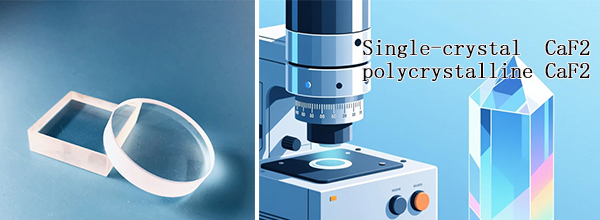
Do single-crystal CaF2 and polycrystalline CaF2 exhibit the same cleavability?
The cleavage properties of single-crystal calcium fluoride and polycrystalline calcium fluoride differ significantly. Single-crystal calcium fluoride exhibits far superior cleavage properties compared to polycrystalline calcium fluoride (ceramic form), with the core distinction lying in the continuity and controllability of the cleavage path.
1. Single-crystal calcium fluoride: Perfect, continuous cleavage
Structural basis: The entire material forms a single, continuous lattice structure without internal boundaries.
Cleavage Process: When external forces (e.g., stress, impact) act upon the single crystal, once a microcrack initiates at a weak point (e.g., defect), it propagates unimpeded along the perfect {111} crystal plane traversing the entire specimen with minimal energy expenditure.
Result: The single crystal fractures neatly and smoothly along cleavage planes, forming mirror-like flat surfaces. This cleavability proves remarkably pronounced and critical.
2. Polycrystalline Calcium Fluoride (CaF₂ Ceramic): Cleavage “Blocked” and “Passivated”
Structural Basis: Composed of numerous randomly oriented micrograins and their intergranular boundaries.
Cleavage Process: Within individual grains, cleavage readily occurs. Cracks can readily propagate along a grain's own {111} planes. However, when a crack reaches a grain boundary, the situation fundamentally changes.
Orientation Shift: The crystal orientations of adjacent grains are random, and their “cleavage-prone” planes are misaligned with the current crack propagation direction. The crack cannot simply “turn” and continue along another grain's {111} plane.
Grain Boundary Resistance: Grain boundaries are regions of disordered atomic arrangement and higher energy, effectively impeding, deflecting, or even blunting the crack tip.
Crack Branching: To continue propagating, the crack may require additional energy to “tear” through the grain boundary or alter its path. This often leads to crack branching, deflection, and the formation of irregular fracture surfaces.
Result: Macroscopic fracture in polycrystalline ceramics no longer exhibits a “cleavage” along a smooth plane. Instead, it follows a mixed pattern of intergranular and transgranular fracture, producing a rough, irregular fracture surface. While macroscopically appearing as brittle fracture, it is no longer “cleavage-prone.”
3. Practical Application Impact
Single-crystal calcium fluoride (used in optical components): Must be handled with extreme care, as even minor edge impacts or stress concentrations can trigger cleavage fractures propagating through the entire lens or window, rendering the component completely unusable.
Polycrystalline calcium fluoride ceramics: While also brittle, its susceptibility to “cleavage cracking” is significantly reduced. Its failure typically involves overall fragmentation rather than clean cleavage along a plane. This makes it potentially more practical for certain applications where optical homogeneity is less critical but shape integrity and reliability are required (e.g., specific windows or substrates), despite its significantly lower light transmission compared to single crystals due to grain boundary scattering.
Conclusion:
Although the crystallographic properties of calcium fluoride ( the fluorite structure with {111} cleavage planes) exist within each grain of both single crystals and polycrystals, the grain boundaries in polycrystalline materials fundamentally alter its macroscopic cleavage susceptibility. Therefore, from an engineering and material performance perspective, we state that single-crystal calcium fluoride is cleavage-prone, while polycrystalline calcium fluoride ceramics are not.
Structural basis: The entire material forms a single, continuous lattice structure without internal boundaries.
Cleavage Process: When external forces (e.g., stress, impact) act upon the single crystal, once a microcrack initiates at a weak point (e.g., defect), it propagates unimpeded along the perfect {111} crystal plane traversing the entire specimen with minimal energy expenditure.
Result: The single crystal fractures neatly and smoothly along cleavage planes, forming mirror-like flat surfaces. This cleavability proves remarkably pronounced and critical.
2. Polycrystalline Calcium Fluoride (CaF₂ Ceramic): Cleavage “Blocked” and “Passivated”
Structural Basis: Composed of numerous randomly oriented micrograins and their intergranular boundaries.
Cleavage Process: Within individual grains, cleavage readily occurs. Cracks can readily propagate along a grain's own {111} planes. However, when a crack reaches a grain boundary, the situation fundamentally changes.
Orientation Shift: The crystal orientations of adjacent grains are random, and their “cleavage-prone” planes are misaligned with the current crack propagation direction. The crack cannot simply “turn” and continue along another grain's {111} plane.
Grain Boundary Resistance: Grain boundaries are regions of disordered atomic arrangement and higher energy, effectively impeding, deflecting, or even blunting the crack tip.
Crack Branching: To continue propagating, the crack may require additional energy to “tear” through the grain boundary or alter its path. This often leads to crack branching, deflection, and the formation of irregular fracture surfaces.
Result: Macroscopic fracture in polycrystalline ceramics no longer exhibits a “cleavage” along a smooth plane. Instead, it follows a mixed pattern of intergranular and transgranular fracture, producing a rough, irregular fracture surface. While macroscopically appearing as brittle fracture, it is no longer “cleavage-prone.”
|
Characteristics |
Single-crystal calcium fluoride |
Polycrystalline calcium fluoride (ceramic) |
|
Structure |
A solid plank with uniformly aligned grain direction |
Plywood formed by forcefully bonding countless small wood blocks with randomly oriented grain |
|
Cleavage/Fracture |
Easily cleaved into smooth halves along grain lines using a chisel |
Difficult to split cleanly. Under stress, fractures propagate along bonding interfaces (grain boundaries) and within wood blocks (crystals) of differing grain orientations, resulting in jagged fracture surfaces |
|
Cleavage Sensitivity |
Extremely high (inherent crystallographic property) |
Extremely low (shows almost no cleavage macroscopically) |
|
Macroscopic Mechanical Behavior |
Highly anisotropic, extremely sensitive to stress in specific directions |
More isotropic overall; strength and toughness (by brittle material standards) typically exceed those of single crystals, as grain boundaries impede crack propagation |
3. Practical Application Impact
Single-crystal calcium fluoride (used in optical components): Must be handled with extreme care, as even minor edge impacts or stress concentrations can trigger cleavage fractures propagating through the entire lens or window, rendering the component completely unusable.
Polycrystalline calcium fluoride ceramics: While also brittle, its susceptibility to “cleavage cracking” is significantly reduced. Its failure typically involves overall fragmentation rather than clean cleavage along a plane. This makes it potentially more practical for certain applications where optical homogeneity is less critical but shape integrity and reliability are required (e.g., specific windows or substrates), despite its significantly lower light transmission compared to single crystals due to grain boundary scattering.
Conclusion:
Although the crystallographic properties of calcium fluoride ( the fluorite structure with {111} cleavage planes) exist within each grain of both single crystals and polycrystals, the grain boundaries in polycrystalline materials fundamentally alter its macroscopic cleavage susceptibility. Therefore, from an engineering and material performance perspective, we state that single-crystal calcium fluoride is cleavage-prone, while polycrystalline calcium fluoride ceramics are not.
Share this:


PREV : The Difference Between Physical Tempering and Chemical Tempering NEXT : Why choose broadband anti-reflective coating(BBAR)?
TALK TO US 86-15584132290
Call us now!
86-15584132290Call us now!

ONLINE CHAT
 2433808388
2433808388