
-
 Email: admin@ytoptics.com
-
 English Inquiry Support:
-
 Add: 2# Automotive InnovationPark,
City,Jilin Province, China
Challenges in the Fabrication of CaF₂ Flat Windows and Control of Transmittance
Calcium fluoride (CaF₂) single crystals, with their broad-spectrum transmission capabilities ranging from vacuum ultraviolet to mid-infrared, have become an indispensable window material in deep-ultraviolet lithography, excimer lasers, and infrared thermal imaging systems. As an ISO 9001-certified manufacturer of precision optical components, Yutai Optics has, since its establishment in 2015, consistently focused its process control efforts on calcium fluoride in the fabrication of flat window products. This article analyzes the material properties, processing bottlenecks, and transmission assurance of calcium fluoride flat windows, supported by specific data.
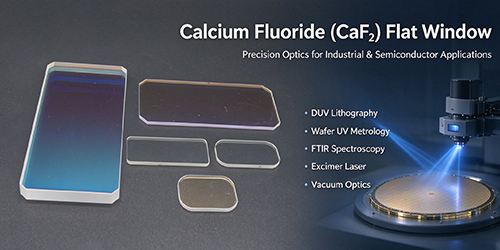
Calcium fluoride has a transmission bandwidth ranging from 180 nm to 8.0 μm, with a refractive index of approximately 1.43286 at 632.8 nm and an extinction coefficient close to zero. The in-crystal transmittance can exceed 99.8%/cm at 248 nm and exceeds 99.6% at 193 nm. Behind these optical advantages lie inherent processing limitations: calcium fluoride has a Mohs hardness of only about 4, with a (111) cleavage plane and low fracture toughness, making it extremely prone to cleavage fractures or subsurface microcracks during grinding and polishing. Research data indicates that the deep, coarse scratches left on the calcium fluoride surface by conventional polishing abrasives are the primary cause of laser-induced damage, directly limiting the service life of the components. Therefore, the process design for flat windows cannot simply replicate glass processing parameters; instead, a balance must be struck between low-stress material removal and surface integrity.
Polishing Reaction Layer: A Hidden Source of Transmittance Loss
For uncoated, double-sided polished calcium fluoride flat plates, transmittance loss due to Fresnel reflection alone is approximately 8%. However, an even more challenging issue lies in the chemical reaction layer introduced during the polishing process. When using traditional cerium dioxide polishing slurries, the slurry reacts with the calcium fluoride surface to form an amorphous residue layer or one with a deviated stoichiometric ratio; this reaction layer exhibits significant absorption in the ultraviolet (UV) spectrum. Academic research has confirmed that cerium oxide soft abrasives tend to adhere to the component surface after reacting with calcium fluoride, causing absorption peaks in the UV spectrum. The core of the process solution to this problem lies in adding a controlled acidic cleaning step after polishing. A brief immersion in dilute nitric acid or dilute acetic acid can effectively strip away the reaction layer and compensate for the loss of surface fluorine; however, the permissible concentration and time window are extremely narrow, and excessive etching can actually worsen surface roughness. In the mass production of calcium fluoride windows, Yutai Optics manages the matching of the polishing solution system and the cleaning formulation as independent process variables, rather than relying on a generic glass cleaning process.
Engineering Implementation of Surface Flatness and Parallelism
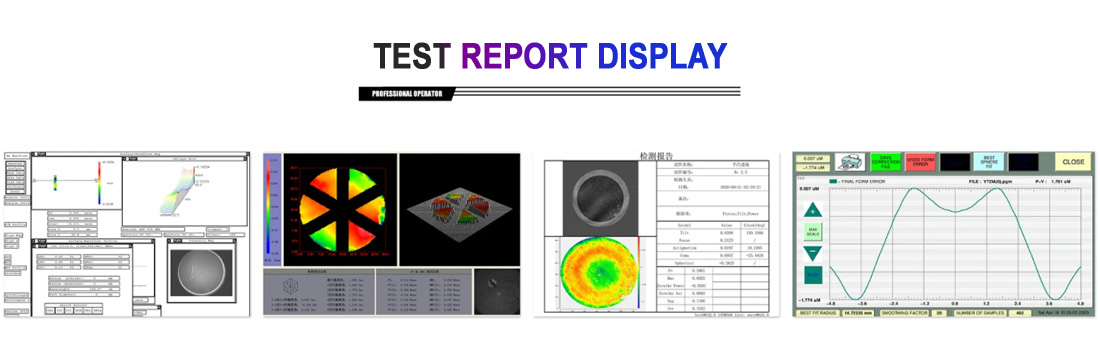
The optical function of a flat window dictates that its core performance metrics focus on transmission wavefront distortion and parallelism. Typical industry specifications for calcium fluoride windows require transmitted wavefront distortion to be better than λ/8 at 633 nm, parallelism to be controlled within 10 arcseconds, and surface roughness to range from 20/10 to 40/20. To simultaneously meet these specifications on soft and brittle materials, the choice of clamping method and polishing parameters is more critical than the grinding grit size. Cutting-edge research indicates that using chemical-mechanical polishing (CMP) technology and balancing chemical and mechanical removal rates can yield a damage-free, ultra-smooth surface on calcium fluoride with a roughness better than 0.1 nm RMS. Yutai Optics is positioned in the small-to-medium batch, medium-to-high precision market, with a 3,800-square-meter facility that integrates rough grinding, fine grinding and polishing, precision coating, and inspection. In the production of flat windows, Yutai employs low-pressure elastic polishing pads combined with a segmented feed strategy to keep the material removal rate at a low level in exchange for stability in surface profile convergence. This approach differs fundamentally from the efficiency-first logic applied to mass-produced glass windows.
The technical challenge in producing calcium fluoride flat windows lies not in pushing a single metric to its limits, but in simultaneously achieving optical uniformity, surface profile accuracy, and transmittance within the constraints of a soft and brittle material. Although the crystal’s intrinsic transmittance can exceed 99.6%, the absorption layers and subsurface damage introduced during processing are sufficient to lower its practical performance by one grade. For manufacturers targeting small- to medium-volume production with medium- to high-precision requirements, focusing on the decoupled control of chemical and mechanical polishing as the core of the process is more practical than pursuing upgrades in equipment specifications. Yutai Optics’ continuous investment and process expertise in calcium fluoride window products serve as a practical demonstration of this approach.


NEXT : Positive Meniscus Lens | A Guide to Understanding This Low-Abberation Optical Lens
 86-15584132290
Call us now!

 2433808388