
-
 Email: admin@ytoptics.com
-
 English Inquiry Support:
-
 Add: 2# Automotive InnovationPark,
City,Jilin Province, China
Applications and Technological Developments of Optical Components in Optoelectronic Systems for Unma
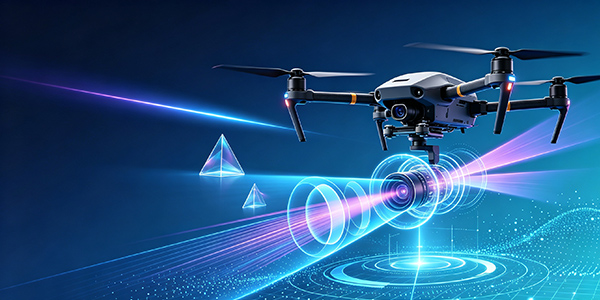
The rapid evolution of the low-altitude economy and intelligent drone technology has propelled drones from conventional aerial photography platforms to all-weather, multi-scenario, high-precision aerial operation platforms. As the core component for environmental perception, data collection, and situational awareness, optical systems serve as the key hardware foundation enabling drones to perform functions such as visual navigation, surveying and inspection, reconnaissance and monitoring, and optical communication.
This paper systematically categorizes the core optical components used in UAVs, analyzes the technical characteristics, suitable operating conditions, and application principles of each component, and—in light of industry demands for lightweight, high-stability, and multimodal fusion—discusses the practical applications of optical components in various UAV operational scenarios. It also summarizes current technical challenges and future development trends, providing a technical reference for the optimized design and engineering applications of UAV optoelectronic systems.
1 Introduction
With the widespread adoption of UAVs in fields such as industrial inspection, aerial surveying, security reconnaissance, emergency response, and low-altitude logistics, the demands for accuracy, timeliness, and interference resistance in UAV environmental perception continue to rise. Compared to traditional sensing methods such as radar and inertial navigation, optical sensing offers advantages including high resolution, intuitive imaging, passive detection, resistance to electromagnetic interference, and controllable costs, making it the core perception method for intelligent UAV operations.
UAV optoelectronic systems generally adhere to the “lightweight, small form factor, and low power consumption (SWaP)” design principles. All onboard optical components must be adapted to the UAV’s specific operating conditions, including high-speed flight, dynamic attitude changes, alternating high and low temperatures, and complex outdoor interference. Unlike traditional ground-based optical equipment, optical components for UAVs must not only ensure imaging accuracy, spectral stability, and zoom performance but also meet mechanical and environmental requirements such as vibration resistance, resistance to wind and sand, salt fog resistance, and wide-temperature operation. The performance of various optical lenses, filter elements, zoom assemblies, optical windows, and communication optical components directly determines the detection range, imaging quality, operational accuracy, and environmental adaptability of UAV electro-optical payloads, and represents one of the core bottlenecks in the advancement of high-end, intelligent UAVs.
2 Classification and Technical Characteristics of Core UAV Optical Components
UAV electro-optical systems are primarily divided into four major technical branches: visible-light imaging, infrared thermal imaging, multispectral sensing, and optical communication. The corresponding optical components can be categorized into four major types: imaging optical components, spectral control components, protective optical components, and optical communication components. Each type of component performs its specific function and works in concert with others to build a multidimensional optical sensing system for UAVs.
2.1 Core Imaging Optical Components
Imaging optical components form the core of a UAV’s visual system. They primarily include fixed-focus/zoom lenses, aspheric lenses, folded-optics lenses, and fluorite ultra-low dispersion (ULS) lenses. Their primary functions are to converge light beams, correct optical paths, and suppress distortion, thereby ensuring clear imaging and long-range detection.
UAV zoom lenses generally employ a precision opto-mechanical integrated design that balances a wide zoom range with extreme lightweight construction. Mainstream industrial-grade UAVs are equipped with 10–240 mm wide-range zoom lenses, enabling seamless switching between close-up detail capture and long-range panoramic reconnaissance. They also integrate optical fog-penetrating technology to enhance imaging clarity in hazy or dusty conditions. To address ghosting and chromatic aberration—common issues in long-focus imaging—high-end inspection and film-grade drone lenses incorporate fluorite optical elements. Thanks to their ultra-low refractive index, these elements effectively eliminate secondary spectral aberrations, significantly improving the purity and resolution of long-distance imaging.
2.2 Spectral Control Optical Components
Spectral control components, centered around optical filters, include neutral density (ND) filters, circular polarizing (CPL) filters, and infrared-cut (IR-cut) filters. These are key supporting components that ensure consistent drone imaging and enhance image quality in complex environments; they are widely used in applications such as aerial surveying, outdoor inspections, and maritime monitoring.
The core function of an ND filter is to uniformly attenuate the brightness of incident visible light without altering the color balance of the image. It addresses overexposure issues during UAV aerial photography and surveying in bright light conditions and ensures a constant shutter speed throughout the day. As such, it is a core component in aerial photogrammetry for ensuring consistent image exposure and improving the accuracy of 3D modeling. IR-cut filters precisely filter out infrared stray light, suppressing interference from the infrared spectrum in natural light on visible-light imaging. They effectively improve color fidelity in daytime imaging and prevent issues such as color cast and blurring.
CPL (Circular Polarizing) filters are primarily used to eliminate reflective glare from water surfaces, glass, and metal equipment surfaces. They play a significant role in scenarios such as photovoltaic power plant inspections, maritime monitoring, bridge inspections, and lake surveying. By penetrating surface reflections to capture true details of equipment and water bodies, they greatly improve defect identification and data collection accuracy. Multispectral UAVs are equipped with customized narrowband filters that precisely select the characteristic spectral bands of vegetation, water bodies, and soil, enabling high-precision operations for agricultural growth monitoring, ecological and environmental monitoring, and resource exploration.
2.3 Protective Optical Components
UAVs are constantly exposed to complex outdoor operating conditions. Impacts from wind and sand, salt fog corrosion, rain and dirt, and extreme temperature fluctuations can easily cause wear, contamination, and fogging of optical lenses, directly reducing image quality or even leading to equipment failure. Protective optical components primarily include optical protection windows and functional coating layers, whose core function is to ensure the long-term stable operation of optoelectronic systems.
The industry’s mainstream protective solution employs optical windows with a sapphire substrate paired with a diamond-like carbon (DLC) coating. The substrate features high hardness and strong impact resistance, while the 2-micrometer-thick DLC coating achieves a hardness of up to 50 GPa and withstands over 2,000 hours of salt fog testing. This effectively resists corrosion in environments such as maritime areas and chemical plants, while also withstanding particle impacts from wind and sand at low altitudes. Furthermore, the superhydrophobic optical surface, produced through femtosecond laser processing, allows rainwater and oil stains to automatically slide off, preventing residue from affecting image quality and significantly reducing maintenance costs for outdoor UAV operations. At the same time, wide-temperature adaptive optical coatings ensure stable optical performance of the components across a temperature range of -40°C to +70°C, meeting the requirements for all-terrain, all-weather operations.
2.4 Optical Communication Components
As the demand for drone swarm operations increases, the limitations of traditional radio communication—such as susceptibility to electromagnetic interference, bandwidth constraints, and poor confidentiality—have become increasingly apparent. Consequently, optical communication components based on optical antennas and intelligent optical reflectors (OIRS) are gradually being implemented. These components offer advantages such as compact size, light weight, resistance to electromagnetic interference, wide communication bandwidth, and strong confidentiality, making them well-suited for dynamic drone swarm networking scenarios.
Ultraviolet optical antennas can capture and amplify ultraviolet communication signals over a wide area without requiring the precise alignment needed for laser communication. They are well-suited to the communication needs of high-speed, dynamically networked UAV swarms and can enable stable interconnection among multiple UAVs even in complex electromagnetic environments. Intelligent optical reflector (OIRS) components enable beam spreading and reconstruction, distributing optical signals from a single drone to multiple drones. This establishes a distributed optical communication and power distribution system for drone swarms, effectively enhancing the coordination efficiency and communication stability of swarm operations.
3 Technical Applications of Optical Components in Core UAV Scenarios
3.1 Aerial Surveying and 3D Modeling
Aerial surveying places extremely high demands on image color accuracy, exposure consistency, and image clarity, making it one of the most mature application scenarios for optical components. This scenario relies primarily on the synergistic effects of ND filters, IR-cut filters, and low-distortion zoom lenses to ensure standardized, high-precision aerial imaging data. ND filters prevent overexposure caused by strong light and standardize exposure parameters for operations throughout the day; IR-cut filters ensure true color reproduction; and low-distortion aspheric lenses correct edge distortion in wide-angle shots, providing precise image data for 3D modeling, topographic surveying, and land surveying, thereby effectively enhancing the accuracy and completeness of aerial triangulation densification and model reconstruction.
3.2 Intelligent Inspection of Industrial Equipment
In industrial scenarios such as power grid inspections, photovoltaic inspections, wind power O&M, and chemical equipment inspections, all-weather defect detection is achieved through the multimodal fusion of visible-light zoom optical systems and infrared optical components. High-magnification visible-light zoom lenses can capture visible defects—such as equipment cracks, loose screws, and damaged wiring—from a distance; infrared optical lenses, utilizing mid-wave infrared optical elements, precisely capture the temperature distribution of equipment to identify latent faults such as overheated wiring, loose connections, and pipeline leaks. Meanwhile, CPL polarizing filters eliminate surface reflections on equipment, resolving blurring issues when imaging metal or glass components and significantly improving defect recognition accuracy. Protective optical coatings ensure the drone’s long-term, stable operation in environments with sandstorms or corrosive industrial settings.
3.3 Security Surveillance and Emergency Rescue
Security and emergency response drones place high demands on detection range, all-weather operational capability, and stealth. They are equipped with lightweight infrared zoom optical assemblies and fog-penetrating optical components. Fog-penetrating lenses utilize special optical path designs and spectral filtering to minimize scattering interference from haze and dust, thereby enhancing detection capabilities in low-visibility environments; Long-focal-length infrared optical lenses enable covert long-range reconnaissance, making them suitable for border patrols and urban security scenarios. In emergency rescue scenarios, multispectral optical components can accurately identify personnel on the ground and heat-emitting targets, rapidly locating trapped individuals in complex environments such as at night, in forested areas, and over water, thereby improving rescue efficiency.
3.4 Optical Communication Networking for UAV Swarms
In scenarios involving UAV swarm formation and collaborative operations, optical communication components overcome the technical bottlenecks of radio communication. Components such as ultraviolet optical antennas and intelligent optical reflectors establish an optical communication network free from electromagnetic interference, enabling dynamic, high-speed networking among multiple drones, real-time data transmission, and precise command exchange. Compared to traditional communication methods, optical communication offers the advantages of high bandwidth, low latency, and strong confidentiality. It supports coordinated reconnaissance and operations by large-scale drone swarms and is suitable for complex scenarios such as low-altitude security, large-scale inspections, and airspace monitoring.
4 Industry Technical Challenges and Development Trends
4.1 Current Core Technical Challenges
At this stage, the application of optical components in UAVs still faces numerous shortcomings:
First, there is a significant conflict between lightweight design and high performance. High-magnification, high-resolution optical lenses tend to be bulky and heavy, making them difficult to integrate into micro-UAVs, while miniaturized lenses generally suffer from zoom distortion and insufficient imaging accuracy at long distances;
Second, multimodal fusion is limited. Visible light, infrared, and multispectral optical systems are configured independently, resulting in poor component integration, which leads to bulky optoelectronic pods and high power consumption;
third, adaptability to extreme environments is insufficient; under conditions of severe vibration, extremely high or low temperatures, and high salt fog, some optical components are prone to issues such as coating peeling, optical path misalignment, and imaging degradation; Fourth, the domestic production rate of high-end optical components remains low; high-end fluorite ultra-low dispersion lenses and high-precision infrared optical components still rely on imports, resulting in higher costs.
4.2 Future Technology Trends
First, integration and miniaturization. By leveraging catadioptric optical path design, composite optical materials, and integrated opto-mechanical technology, we will achieve high-level integration of multispectral, visible-light, and infrared optical components, further reducing the size and weight of the optical system to accommodate micro-UAVs and portable operational equipment.
Second, multimodal intelligent fusion. Through optical path optimization and algorithm adaptation, achieve synchronous, co-source acquisition of multispectral, infrared, and visible light imaging data; combined with AI algorithms, enable intelligent noise reduction, defect identification, and dynamic tracking in optical imaging.
Third, upgrades for high environmental adaptability. New composite coating technologies—including superhydrophobic, wear-resistant, and high/low-temperature-resistant coatings—are continuously being iterated to enhance the stability and service life of optical components under extreme operating conditions, enabling all-terrain, all-weather operations.
Fourth, cost-effective domestic production and iterative development. Breakthroughs in core fabrication technologies for high-end infrared optical materials, ultra-low dispersion optical lenses, and precision spectral control components have reduced the cost of high-end UAV optoelectronic systems.
Fifth, widespread adoption of intelligent optical communication. Continuous optimization of optical communication components—such as optical antennas and smart reflective surfaces—is driving the large-scale implementation of optical communication networks for UAV swarms, achieving the integration of communication, sensing, and positioning.
Optical components serve as the core foundational hardware for UAV optoelectronic sensing and information transmission systems; their performance directly determines a UAV’s operational precision, environmental adaptability, and level of intelligence. From basic visible-light imaging and spectral modulation to advanced infrared detection and optical networking communications, the iterative upgrades of various optical components continue to expand the boundaries of UAV applications, driving the evolution of UAVs from simple imaging tools to multidimensional, high-precision, and intelligent aerial operation platforms. In the future, with continuous breakthroughs in optical materials, precision opto-mechanical design, and multimodal fusion technology, lightweight, integrated, highly reliable, and domestically produced optical components will become the industry standard, comprehensively empowering high-quality development in fields such as the low-altitude economy, industrial inspections, security and emergency response, and intelligent surveying and mapping.


PREV : [7D11] The 27th China International Optoelectronic Exposition NEXT : Broadband Anti-Reflection Coating (BBAR): From Principles to Applications—Unlocking the “Transparenc
 86-15584132290
Call us now!

 2433808388