ISO9001 Certified Professional Manufacturer & Supplier of Optics
+86-0431-87911611 admin@ytoptics.com

Contact us
-
 Email: admin@ytoptics.com
-
 English Inquiry Support:
-
 Add: 2# Automotive InnovationPark,
City,Jilin Province, China
Guide to the Structural Characteristics and Applications of Fresnel Lenses
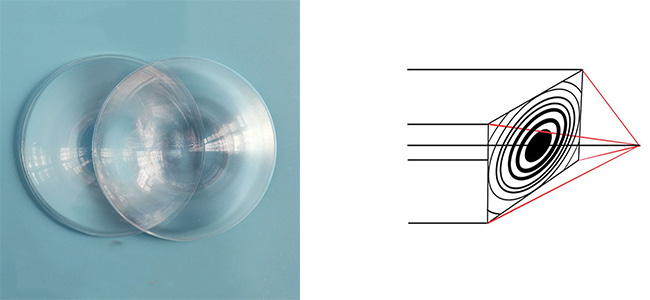
A Fresnel lens, also known as a spiral lens, is typically a thin sheet made by injection molding polyolefin materials, though some are made of glass. One side of the lens is smooth, while the other is engraved with concentric circles that gradually increase in size. Its pattern is designed based on the requirements for light interference, diffraction, relative sensitivity, and reception angle.
 I. Core Classifications and Structural Characteristics of Fresnel Lenses
Fresnel lenses feature concentric annular grooves (Fresnel bands) on their surface, with a sawtooth-shaped cross-section. Each groove can be regarded as a miniature lens. Based on their optical functions and applications, they are primarily classified into three categories:
1. Positive Fresnel Lens:
Its core structure consists of a convex ring with concave grooves. When light enters, it is refracted to converge at a focal point or converted into parallel light, with the focal point and the incident light rays located on opposite sides of the lens. Typical characteristics: Light transmittance ≥90%, focusing efficiency ≥85%, and a weight that is only 1/10 to 1/5 that of a traditional convex lens. Applications include concentrated photovoltaic (CPV) systems, VR headsets, and projection equipment.
2. Negative Fresnel Lens:
The core structure consists of a concave annular groove, with the focal point located on the same side as the incident light. The surface is typically coated with a reflective layer, primarily to achieve light divergence or reflection. Typical characteristics include a divergence angle of 15°–120°, an aluminum coating reflectivity of ≥95%, and a compact design. Applications include infrared sensors, LiDAR systems, and lighthouse reflectors.
3. Linear Fresnel Lenses:
These lenses feature parallel linear grooves that focus light in only one direction, while rays in the opposite direction remain parallel. They are easy to manufacture, cost-effective, and can be fabricated into flexible structures. They are used in solar thermal power generation, industrial machine vision lighting, and traffic signal light distribution, among other applications.
II. Key Factors Affecting the Optical Performance of Fresnel Lenses
1. Structural Parameters
Key parameters include pitch (0.1–1 mm), focal length (short focal length: 5–20 mm for micro-devices; long focal length: 50–200 mm for spot-lighting applications), and tooth angle. An angular deviation exceeding 0.5° will result in a decrease in spot-lighting efficiency of more than 10%.
2. Material Properties
The most commonly used materials are optical plastics (acrylic, with a light transmittance of 92%–95%, suitable for indoor use; and PC, which is impact-resistant and heat-resistant, suitable for outdoor use); optical glass has a light transmittance of 95%–98% and is suitable for high-precision applications; applying an anti-reflective coating to the surface can increase light transmittance to over 98%.
3. Machining Accuracy
Key accuracy requirements: Tooth profile accuracy ±0.01 mm, surface roughness Ra ≤ 0.2 μm, flatness ≤ 0.1 mm/m. Insufficient accuracy will result in increased stray light and blurred images.
4. Operating Environment
High temperatures (>80°C) may cause deformation, while low temperatures (<-20°C) may cause brittleness and cracking; high humidity may lead to fogging and mold growth; surface scratches and dust can reduce light-gathering efficiency; avoid using organic solvents when cleaning.
III. Methods for Testing the Performance of Fresnel Lenses
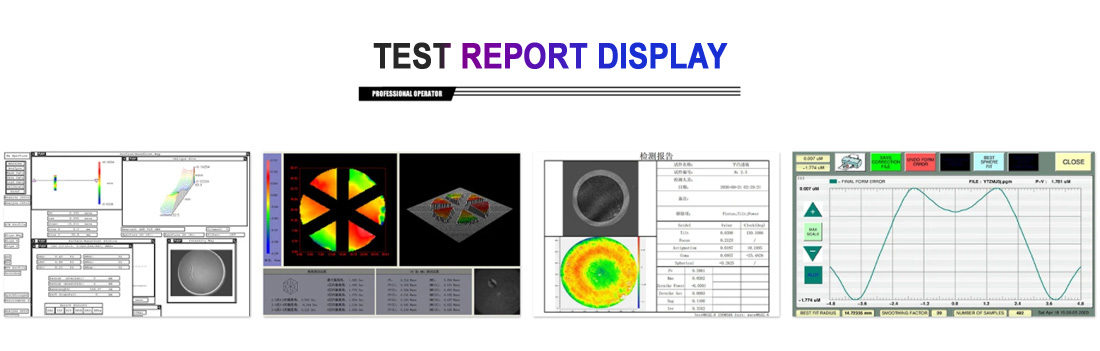
The instruments commonly used include spectrophotometers, profilometers, and interferometers. The core process is as follows:
1. Sample Preparation
Secure the sample so that it lies flat, and allow it to equilibrate for 30 minutes at room temperature (23±2°C) and relative humidity (50±5% RH) to eliminate thermal stress.
2. Core Parameter Testing
Light transmittance testing (average value across target wavelength bands, ≥90%); structural accuracy testing (scanning groove parameters, in accordance with design requirements); light-gathering efficiency testing (convex lens ≥85%).
3. Appearance and Environmental Stability Testing
Microscopic inspection reveals no scratches or bubbles; after high-low temperature cycling (-40°C to 85°C) and damp heat (85°C, 95% RH) testing, performance deviation is ≤5% and the surface shows no abnormalities.
IV. Applications of Fresnel Lenses
1. New Energy Sector
In CPV systems and solar thermal power generation, the concentration ratio can reach 500 to 1,000 times, thereby improving solar energy utilization efficiency.
2. Consumer Electronics
VR/AR devices (thinner optical modules), ultra-short-throw projectors (projecting large images from close range), and camera focusing screens (improved brightness uniformity).
Summary Table of the Key Advantages of Fresnel Lenses
Fresnel lenses feature concentric annular grooves (Fresnel bands) on their surface, with a sawtooth-shaped cross-section. Each groove can be regarded as a miniature lens. Based on their optical functions and applications, they are primarily classified into three categories:
1. Positive Fresnel Lens:
Its core structure consists of a convex ring with concave grooves. When light enters, it is refracted to converge at a focal point or converted into parallel light, with the focal point and the incident light rays located on opposite sides of the lens. Typical characteristics: Light transmittance ≥90%, focusing efficiency ≥85%, and a weight that is only 1/10 to 1/5 that of a traditional convex lens. Applications include concentrated photovoltaic (CPV) systems, VR headsets, and projection equipment.
2. Negative Fresnel Lens:
The core structure consists of a concave annular groove, with the focal point located on the same side as the incident light. The surface is typically coated with a reflective layer, primarily to achieve light divergence or reflection. Typical characteristics include a divergence angle of 15°–120°, an aluminum coating reflectivity of ≥95%, and a compact design. Applications include infrared sensors, LiDAR systems, and lighthouse reflectors.
3. Linear Fresnel Lenses:
These lenses feature parallel linear grooves that focus light in only one direction, while rays in the opposite direction remain parallel. They are easy to manufacture, cost-effective, and can be fabricated into flexible structures. They are used in solar thermal power generation, industrial machine vision lighting, and traffic signal light distribution, among other applications.
II. Key Factors Affecting the Optical Performance of Fresnel Lenses
1. Structural Parameters
Key parameters include pitch (0.1–1 mm), focal length (short focal length: 5–20 mm for micro-devices; long focal length: 50–200 mm for spot-lighting applications), and tooth angle. An angular deviation exceeding 0.5° will result in a decrease in spot-lighting efficiency of more than 10%.
2. Material Properties
The most commonly used materials are optical plastics (acrylic, with a light transmittance of 92%–95%, suitable for indoor use; and PC, which is impact-resistant and heat-resistant, suitable for outdoor use); optical glass has a light transmittance of 95%–98% and is suitable for high-precision applications; applying an anti-reflective coating to the surface can increase light transmittance to over 98%.
3. Machining Accuracy
Key accuracy requirements: Tooth profile accuracy ±0.01 mm, surface roughness Ra ≤ 0.2 μm, flatness ≤ 0.1 mm/m. Insufficient accuracy will result in increased stray light and blurred images.
4. Operating Environment
High temperatures (>80°C) may cause deformation, while low temperatures (<-20°C) may cause brittleness and cracking; high humidity may lead to fogging and mold growth; surface scratches and dust can reduce light-gathering efficiency; avoid using organic solvents when cleaning.
III. Methods for Testing the Performance of Fresnel Lenses
The instruments commonly used include spectrophotometers, profilometers, and interferometers. The core process is as follows:
1. Sample Preparation
Secure the sample so that it lies flat, and allow it to equilibrate for 30 minutes at room temperature (23±2°C) and relative humidity (50±5% RH) to eliminate thermal stress.
2. Core Parameter Testing
Light transmittance testing (average value across target wavelength bands, ≥90%); structural accuracy testing (scanning groove parameters, in accordance with design requirements); light-gathering efficiency testing (convex lens ≥85%).
3. Appearance and Environmental Stability Testing
Microscopic inspection reveals no scratches or bubbles; after high-low temperature cycling (-40°C to 85°C) and damp heat (85°C, 95% RH) testing, performance deviation is ≤5% and the surface shows no abnormalities.
IV. Applications of Fresnel Lenses
1. New Energy Sector
In CPV systems and solar thermal power generation, the concentration ratio can reach 500 to 1,000 times, thereby improving solar energy utilization efficiency.
2. Consumer Electronics
VR/AR devices (thinner optical modules), ultra-short-throw projectors (projecting large images from close range), and camera focusing screens (improved brightness uniformity).
Summary Table of the Key Advantages of Fresnel Lenses
|
Category of Strengths |
Description of Specific Advantages |
The corresponding core values |
|
Structural Advantages |
Featuring a lightweight, thin ring-shaped groove structure that replaces traditional, bulky lenses, it weighs only 1/10 to 1/5 as much as a traditional convex lens. |
Enables the miniaturization and weight reduction of optical systems, saving installation space
|
|
Optical Performance Advantages |
Retains high-efficiency light-gathering and collimation capabilities, with a light transmittance of ≥90% and a focusing efficiency of ≥85%; in some cases, these values can be improved to over 98% through coating. |
Excellent optical performance, meeting the focusing, collimation, and divergence requirements of various applications |
|
Cost advantage |
It is material-saving, has moderate processing difficulty (especially for linear models), can be mass-produced, and offers cost-effective optical plastics as a material option. |
Reduce production and application costs, and enable large-scale deployment across various scenarios, including consumer and industrial applications |
|
Adaptability Advantages |
Available in three types—positive, negative, and linear—with customizable dimensions and focal lengths to meet various optical requirements; available in plastic or glass, suitable for consumer, high-precision, and outdoor applications |
With a wide range of applications, it can be flexibly adapted to meet the needs of various sectors, including new energy, consumer electronics, and industry. |
Share this:


PREV : A ‘thinner’ lens is not necessarily simpler NEXT : With its exceptional performance, fused silica leads the way in high-end optical applications
TALK TO US 86-15584132290
Call us now!
86-15584132290Call us now!

ONLINE CHAT
 2433808388
2433808388