ISO9001 Certified Professional Manufacturer & Supplier of Optics
+86-0431-87911611 admin@ytoptics.com

Contact us
-
 Email: admin@ytoptics.com
-
 English Inquiry Support:
-
 Add: 2# Automotive InnovationPark,
City,Jilin Province, China
Analysis of Tempered Glass
Doesn't tempered glass shatter?
Tempered glass is a safety glass that undergoes a special process to significantly enhance its strength. However, tempering does not mean it won't break when dropped. Tempered glass can still break, but the outcome is entirely different from ordinary glass. When tempered glass breaks, it shatters into small, granular pieces.
As shown in the image:
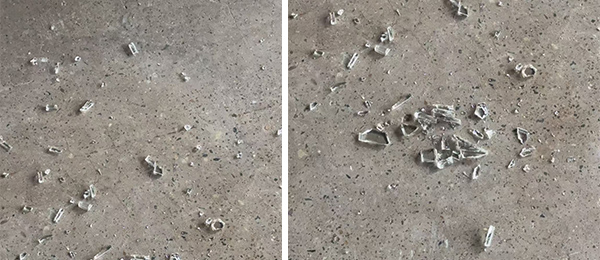
When irregularly shaped tempered glass lands on its sides or corners, it is prone to shattering. If the larger surface area hits first, it is highly unlikely to break.
To ensure safety when using tempered glass products, observe the following precautions:
(1) Inspect appearance: Examine the glass in well-lit conditions. It should be free of visible bubbles, impurities, scratches, or other defects.
(2) Apply safety film to critical areas: For locations with safety risks, such as shower enclosures and bathroom partitions, apply safety film to the inner surface of the glass. This prevents shards from scattering if the glass breaks, as the film holds the fragments in place.
(3) Avoid impact on edges and corners: The edges and corners of tempered glass are relatively fragile. Avoid striking them with hard objects during installation and use.
Comparison of Physical and Chemical Tempering
Physical tempering is “thermodynamically driven.” Glass is heated to its softening point, then rapidly cooled by cold air. The surface solidifies instantly while the interior continues to cool and contract slowly. This “time lag” causes the solidified surface to exert tensile stress on the still-cooling interior, creating powerful compressive stress at the surface.
Chemical tempering is “chemically driven.” Glass is immersed in a high-temperature molten potassium nitrate salt bath, where sodium ions in the glass surface exchange with larger potassium ions in the molten salt. These larger potassium ions squeeze into the glass network structure, effectively “stretching” the surface layer outward to form a compressive stress zone.
To ensure safety when using tempered glass products, observe the following precautions:
(1) Inspect appearance: Examine the glass in well-lit conditions. It should be free of visible bubbles, impurities, scratches, or other defects.
(2) Apply safety film to critical areas: For locations with safety risks, such as shower enclosures and bathroom partitions, apply safety film to the inner surface of the glass. This prevents shards from scattering if the glass breaks, as the film holds the fragments in place.
(3) Avoid impact on edges and corners: The edges and corners of tempered glass are relatively fragile. Avoid striking them with hard objects during installation and use.
Comparison of Physical and Chemical Tempering
Physical tempering is “thermodynamically driven.” Glass is heated to its softening point, then rapidly cooled by cold air. The surface solidifies instantly while the interior continues to cool and contract slowly. This “time lag” causes the solidified surface to exert tensile stress on the still-cooling interior, creating powerful compressive stress at the surface.
Chemical tempering is “chemically driven.” Glass is immersed in a high-temperature molten potassium nitrate salt bath, where sodium ions in the glass surface exchange with larger potassium ions in the molten salt. These larger potassium ions squeeze into the glass network structure, effectively “stretching” the surface layer outward to form a compressive stress zone.
|
Project |
Physical Tempering (Wind Tempering) |
Chemical Tempering (Ion Exchange) |
|
Core Principle |
Through rapid cooling, the surface layer of the glass hardens and contracts first, followed by the interior cooling. This process creates compressive stress on the surface and tensile stress within the interior. |
In high-temperature molten salts, large ions (such as K⁺) displace small ions (such as Na⁺) from the glass surface layer, causing the surface layer to “expand” and form a compressive stress layer. |
|
Suitable for glass |
Ordinary soda-lime-silica glass (doors, windows, home appliances, furniture, etc.). |
Specialty or thin glass, such as ultra-thin glass, aerospace glass, display covers (mobile phone/watch screens), and high-silica/borosilicate glass. |
|
Stress layer depth |
Deep (reaching 1/6 to 1/3 of the glass thickness), for example, the stress layer in 6mm glass is approximately 1mm. |
Shallow (typically tens to hundreds of micrometers), but stress values can be extremely high. |
|
Product Strength |
Its bending strength and impact resistance are 3 to 5 times greater than that of ordinary glass. |
Exceptionally high surface hardness with outstanding scratch resistance and bending strength, making it particularly suitable for thin glass. |
|
Safety |
When broken, it forms particles without sharp edges, making it a type of safety glass. |
The fragmentation pattern may not meet safety glass standards and could produce large fragments. |
|
Thermal Stability |
Excellent, capable of withstanding a temperature difference of approximately 250°C. |
Generally, prolonged exposure to high temperatures may lead to stress relaxation. |
|
Shape restrictions |
once tempered, it cannot undergo further processing such as cutting or drilling. |
Can be tempered into complex shapes such as irregular forms, perforated designs, and ultra-thin profiles, and can be cut again after tempering. |
|
Typical thickness |
Thicker, typically over 3mm. |
Ultra-thin, capable of processing glass ranging from 0.1mm to 3mm. |
|
Cost and Production Capacity |
Low cost, high production capacity, suitable for large-scale standardized production. |
High cost, low production capacity, suitable for small-batch, high-value-added products. |
The choice of process depends entirely on product requirements:
(1) Opt for physical tempering:
When prioritizing cost-effectiveness and high strength (architectural doors/windows, shower enclosures, furniture countertops, appliance panels).
When requiring safety glass fragmentation properties (balcony railings, glass partitions).
For thicker products with regular shapes that require no further processing.
(2) Choose chemical tempering:
For ultra-thin, complex shapes (cover glass for smartphones, smartwatches, tablets).
Requires exceptional surface hardness and scratch resistance.
For specialty glass types (high-alumina silica, borosilicate glass).
Products requiring precision cutting or drilling after tempering.
An illustrative analogy: Physical tempering is like equipping glass with thick, resilient “full-body armor,” offering robust overall protection. Chemical tempering, conversely, coats the glass surface with an ultra-hard, ultra-thin “diamond film,” providing exceptional scratch resistance but less overall toughness than the former.
Share this:


PREV : ASIA PHOTONICS EXPO 2026 (4 - 6 February 2026) NEXT : The Difference Between Physical Tempering and Chemical Tempering
TALK TO US 86-15584132290
Call us now!
86-15584132290Call us now!

ONLINE CHAT
 2433808388
2433808388